


Below is a YouTube video version of my Substack article, Why Mormons Aren’t Christians, followed by responses to this video. I choose to respond to these replies here because YouTube’s comment section isn’t conducive to clear communication when it comes to sharing charts, timelines, longer replies, etc.
In response to the video above, are @Wendler904’s responses below followed by mine.
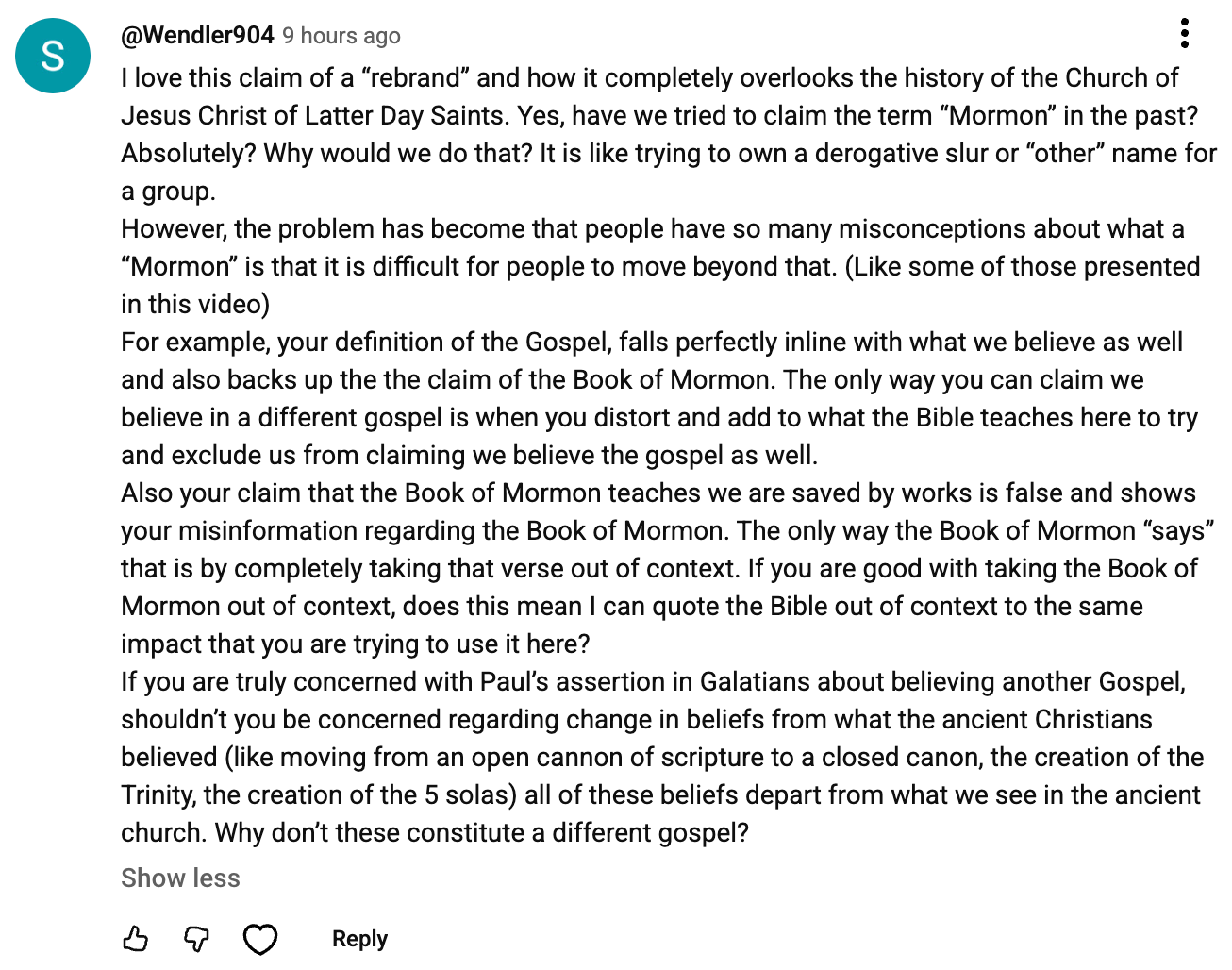
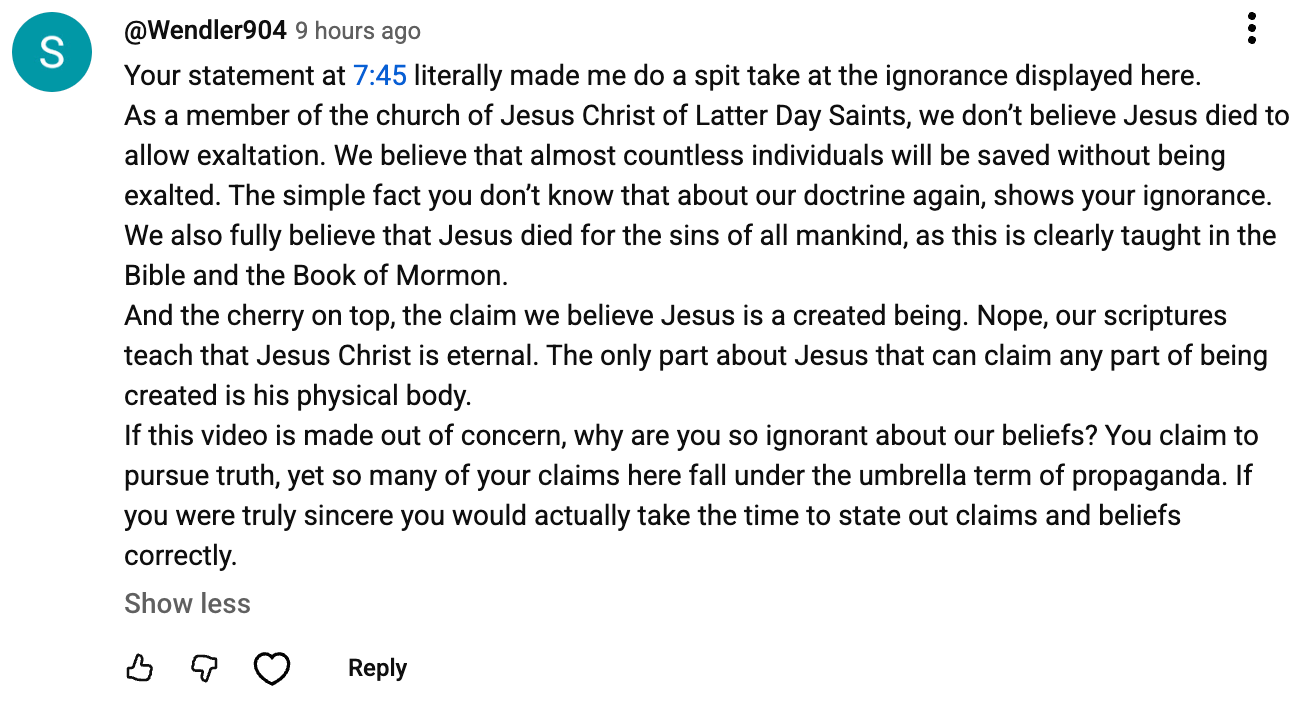
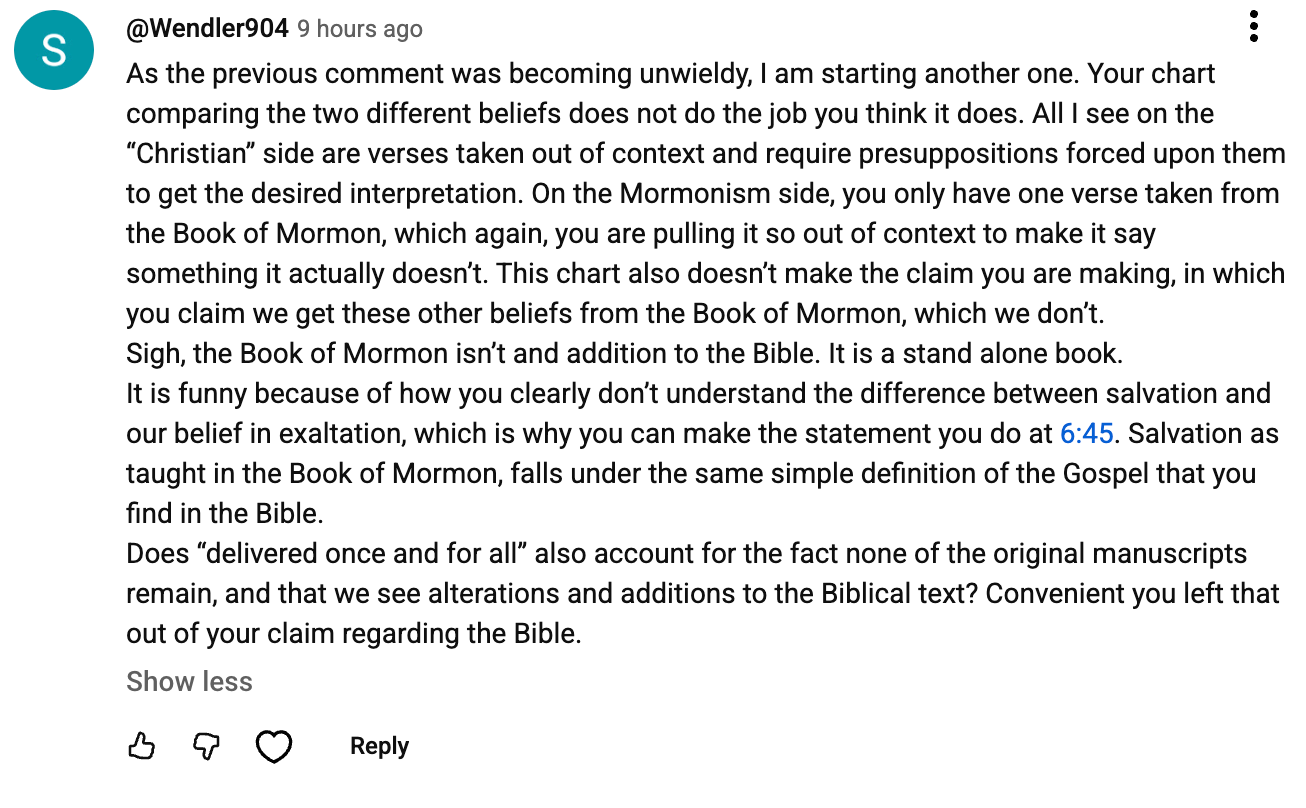
Thank you for taking the time to respond at length. I appreciate the passion you bring to defending what you hold dear. As a minister of the gospel, my aim is not to win an argument but to speak the truth in love (Eph 4:15), contending earnestly for the faith once-for-all delivered to the saints (Jude 3). Let’s walk through your points exegetically, staying tethered to the text of Scripture and the actual claims of LDS sources, without heat or caricature.
1. On the “Rebrand” and the Term “Mormon”
You’re right that the LDS organization has historically embraced “Mormon” (e.g., the 2010–2018 “I’m a Mormon” campaign) and now discourages it. President Nelson’s 2018 general conference address explained that “Mormon” diminishes the centrality of Jesus Christ. That is a legitimate pastoral concern.
Yet the shift does not erase the doctrinal chasm. The issue is not the label but the substance beneath shared vocabulary. As noted in the video, “sharing vocabulary does not mean sharing a dictionary.”
The question remains: Which Jesus? Which gospel? Which God?
2. The Gospel: Same Definition?
You assert that LDS belief in the gospel “falls perfectly in line” with 1 Corinthians 15:3–4 and that I distort Scripture in the video to exclude you as a Mormon/LDS member. Let’s test that claim against the primary LDS sources first referencing 1 Corinthians 15:3–4 as I did in the video, for context:
> 3 For I delivered to you as of first importance what I also received: that Christ died for our sins in accordance with the Scriptures, 4 that he was buried, that he was raised on the third day in accordance with the Scriptures,
Paul grounds the gospel in the Old Testament fulfillment, not post-apostolic revelation. The LDS Articles of Faith #4, however, states:
“first principles … 1. Faith in the Lord Jesus Christ; 2. Repentance; 3. Baptism …; 4. Laying on of hands …”
The official *Gospel Topics Essay* (“Salvation”) clarifies:
“Latter-day Saints believe salvation comes through the grace of Jesus Christ and* obedience to the laws and ordinances of the gospel.”
But Ephesians 2:8–9 is unequivocal:
“For by grace you have been saved through faith; and this is not of yourselves, it is the gift of God; not a result of works, so that no one may boast.”
The Greek ouk ex ergōn (“not of works”) is absolute. Titus 3:5 reinforces:
“He saved us, not on the basis of deeds which we have done in righteousness, but according to His mercy.”
The Book of Mormon itself, in 2 Nephi 25:23, states:
“for we know that it is **by grace that we are saved, after all we can do.”
The phrase, “after all we can do,” make grace contingent upon human effort; precisely what Paul anathematizes in Galatians 5:4:
“You have been severed from Christ, you who are seeking to be justified by law; you have fallen from grace.”
You claim I take 2 Nephi 25:23 “out of context.” The immediate context (vv. 24–26) speaks of *offering sacrifices* and *keeping the law of Moses* until Christ; yet even here, grace is subsequent to maximal effort. This is not the Biblical gospel of prevenient grace (Rom 5:8; Eph 2:5).
(Prevenient Grace- “to come before”) is entirely a gift from God—unmerited, unearned, and initiated solely by Him. It is the grace that precedes and enables any human response to God. Think of it as grace that is waiting on us to receive, not work to attain through our efforts.
Biblical Basis:
Romans 5:8 – “But God demonstrates His own love toward us, in that while we were still sinners, Christ died for us.” → Grace comes before we repent or believe.
Ephesians 2:5 – “Even when we were dead in our transgressions, [God] made us alive together with Christ (by grace you have been saved).” → Spiritual life (regeneration) is given while we are dead—not after we act.
John 6:44 – “No one can come to Me unless the Father who sent Me draws him.” → The drawing (Greek: helkysē) is God’s prior action.
3. The Chart: “Out of Context”?
You argue the biblical citations require “presuppositions forced upon them.” Let’s examine each, letting the text speak.
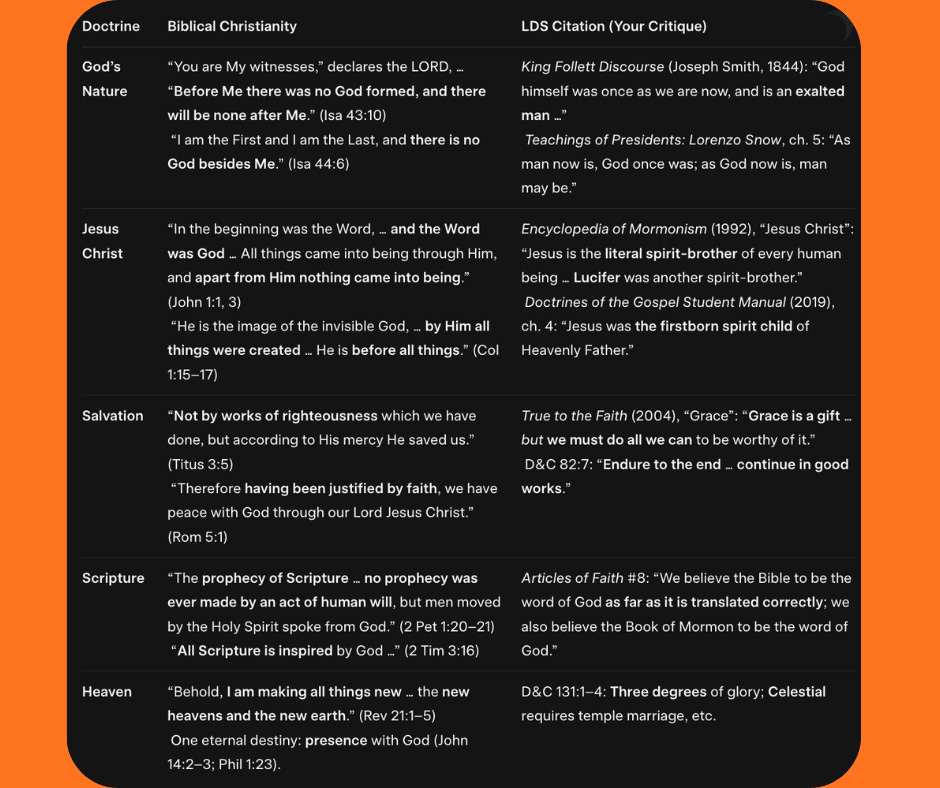
As you can see, these are not “presuppositions.” They are the plain grammatical-historical reading of the text. The LDS citations are from official publications, not fringe voices.
4. “Salvation” vs. “Exaltation”?
You distinguish general salvation (resurrection) from exaltation (godhood). Fair. Yet the New Testament makes no such distinction. Scripture itself never divides salvation in this way.
John 3:36: “He who believes in the Son has eternal life; but he who does not obey the Son will not see life.”
Belief = possession of *zoē aiōnios* (eternal life)— not mere resurrection.
Romans 8:16–17: Believers are “co-heirs with Christ”—not future gods, but adopted sons sharing His glory as creatures (not gods).
1 John 5:11–13: “God has given us eternal life, and this life is in His Son. He who has the Son has the life.”
The LDS general salvation (resurrection for all, per D&C 76) is not the biblical “eternal life.” The latter is union with the Biblical Triune God, not progression to divinity.
5. Closed Canon & “Ancient Christianity”
You ask why a closed canon or the Trinity constitutes “another gospel.” Great question!
Jude 3: “the faith once for all delivered (hapax paradidōmi) to the saints.” The Greek hapax is final, no sequel. This is why interpreting Scripture in context is imperative. If you don’t, you end up making Scripture mean whatever you desire it to.
Revelation 22:18–19: Applies to the book of Revelation, yet the principle of finality echoes Deuteronomy 4:2; Proverbs 30:6.
Hebrews 1:1–2: “God … in these last days has spoken to us in His Son.” The climax of revelation is Christ, not 1830 in upstate New York from a 14 year old claiming he saw God and Jesus in unmediated glory, which is another unbiblical claim further address here.
The Trinity is not a 4th-century invention:
Ignatius (AD 110): “Jesus Christ … who is God and man” (Ephesians 7:2).
Irenaeus (AD 180): “One God, the Father … one Christ Jesus, the Son of God, who became incarnate” (“Against Heresies” 1.10.1).
Tertullian (AD 200): Coined Trinitas (“Against Praxeas”).
The 5 Solas arise from Sola Scriptura—Scripture’s self-attestation (2 Tim 3:16) and sufficiency (Ps 119:160; John 17:17).
6. Textual Variants?
You note no original manuscripts remain. True. Yet the science of textual criticism gives us >99% certainty of the original text.
The variants that affect doctrine (e.g., 1 John 5:7 KJV) are footnoted in modern translations. The core gospel: Christ’s deity, death, resurrection, salvation by grace stands in every major manuscript family (Alexandrian, Byzantine, Western).
The issue is not sincerity but sufficiency. The biblical Jesus is the “eternal Son” (Micah 5:2; John 8:58), “uncreated” Creator (Col 1:16), who “alone” atones (Heb 10:10–14).
No temple endowment, no eternal marriage, no celestial progression can add to His finished work (John 19:30).
“There is one God, and One Mediator also between God and men, the man Christ Jesus.” (1 Tim 2:5)
I invite you not to abandon kindness or family, but to test every claim against the unchanging Word (Acts 17:11). The stakes are literally eternal. Let’s reason together from the text, in humility and love.
Grace and peace in the One, Jesus Christ, who alone atones,
Rob Alsobrook
Your response actually perfectly encapsulates many of my arguments made against your claims, which makes me laugh at how how overly hard you have to work at covering up and distorting the argument. Since you are correct that this format is not conducive for lengthy comments, I am going to focus on only one here.
Your continued use of 2nd Nephi 25:23 to claim that we (and the Book of Mormon) believe in a works based salvation. You purposefully avoided my claim of you taking that verse out of context, to then double down on removing it out of context, and then implying an alternative meaning to the phrase, "all you can do".
Yes, the phrase of "all you can do" does imply effort on our part. The problem with your claims are, you are implying that "all you can do" is talking about New Testament style works such as baptism. It is not, which is one point to emphasize as to the fact you are taking it out of context.
When you put the verse and the phrase "after all you can do" with the actual context of the verse, you see that it is talking about obeying the Law of Moses.
You see, in context, this verse is describing the beliefs of a Jewish culture who believed in the Savior and the atonement he would provide for all of us. Yet because they lived in a time that the law hadn't been fulfilled, knew they were still under commandment to obey the Law of Moses to the best of their ability. Thus they would be saved by grace (through the atonement of Jesus Christ) Yet knew that they still needed to obey the Law of Moses (after all they could do)
To emphasize how badly you must ignore the context of this verse to reach your conclusion, why don't you include the verses after verse 23? If your interpretation is valid, the next verses would no doubt back up your claim, right? Lets read the verses together and see if they imply what you are claiming they imply?
23 For we labor diligently to write, to persuade our children, and also our brethren, to believe in Christ, and to be reconciled to God; for we know that it is by grace that we are saved, after all we can do.
24 And, notwithstanding we believe in Christ, we keep the law of Moses, and look forward with steadfastness unto Christ, until the law shall be fulfilled.
25 For, for this end was the law given; wherefore the law hath become dead unto us, and we are made alive in Christ because of our faith; yet we keep the law because of the commandments.
26 And we talk of Christ, we rejoice in Christ, we preach of Christ, we prophesy of Christ, and we write according to our prophecies, that our children may know to what source they may look for a remission of their sins.
27 Wherefore, we speak concerning the law that our children may know the deadness of the law; and they, by knowing the deadness of the law, may look forward unto that life which is in Christ, and know for what end the law was given. And after the law is fulfilled in Christ, that they need not harden their hearts against him when the law ought to be done away.
If you are going to imply any "New Testament" style implications from this verse, I could argue the New Testament commands us to do many things, Yet salvation is only found through belief in Jesus Christ. Those things we are commanded to do don't actually save us. Your continued use of taking this verse out of context doesn't back up the claims you are giving it. Hence why I find your continued use of thisargument about this verse particularly galling.
I am open to addressing more of your claims here, as your Gish-Gallop of arguments here all share a certain level of deception on your case to make.