


From the serpent’s promise in Eden to the Mormon doctrine of exaltation, the question remains: Did God really say?
While I didn’t become a Christian until I was an early twenty-something in college in the early 2000s, I did grow up in the Bible Belt of Tennessee. Looking back, though, I can’t remember ever hearing that Adam and Eve’s disobedience wasn’t considered flat-out sin.
But what if I told you that Adam and Eve did not actually sin when they ate the fruit God explicitly commanded them not to eat?
You might reasonably ask, “Then what exactly would count as sin?” Or, if, like me, you grew up in a heavily Christian context, whether you’re a Christian or not, you might think, “Umm. No. That’s not how the story goes.”
It wasn’t until recently, though, that I learned this is exactly what Mormonism believes.
According to a distinctive teaching of Mormonism—or as they refer to themselves, “the Church of Jesus Christ of Latter-day Saints”—Adam and Eve transgressed, but they did not sin. Hang with me.
That might sound like a minor theological technicality. It isn’t.
Redefining humanity’s original sin can redirect an entire religious system’s understanding of what humanity needs from Jesus Christ.
And Mormonism is one system that does precisely that.
The consequences reach far beyond Genesis. They affect how we understand God’s character, human rebellion, Christ’s Atonement, salvation, and the ultimate purpose of human existence.
But before examining Mormon doctrine, we need to return to the beginning.
1. The Oldest Trick in the Book
The first recorded attack against humanity did not begin with an army or a weapon. It began with a question.
“Did God actually say…?” (Genesis 3:1).
Satan did not begin by denying God’s existence. He began by questioning God’s Word.
Then he contradicted God’s warning: “You will not surely die” (Genesis 3:4).
Finally came the promise: “You will be like God” (Genesis 3:5).
Notice the progression:
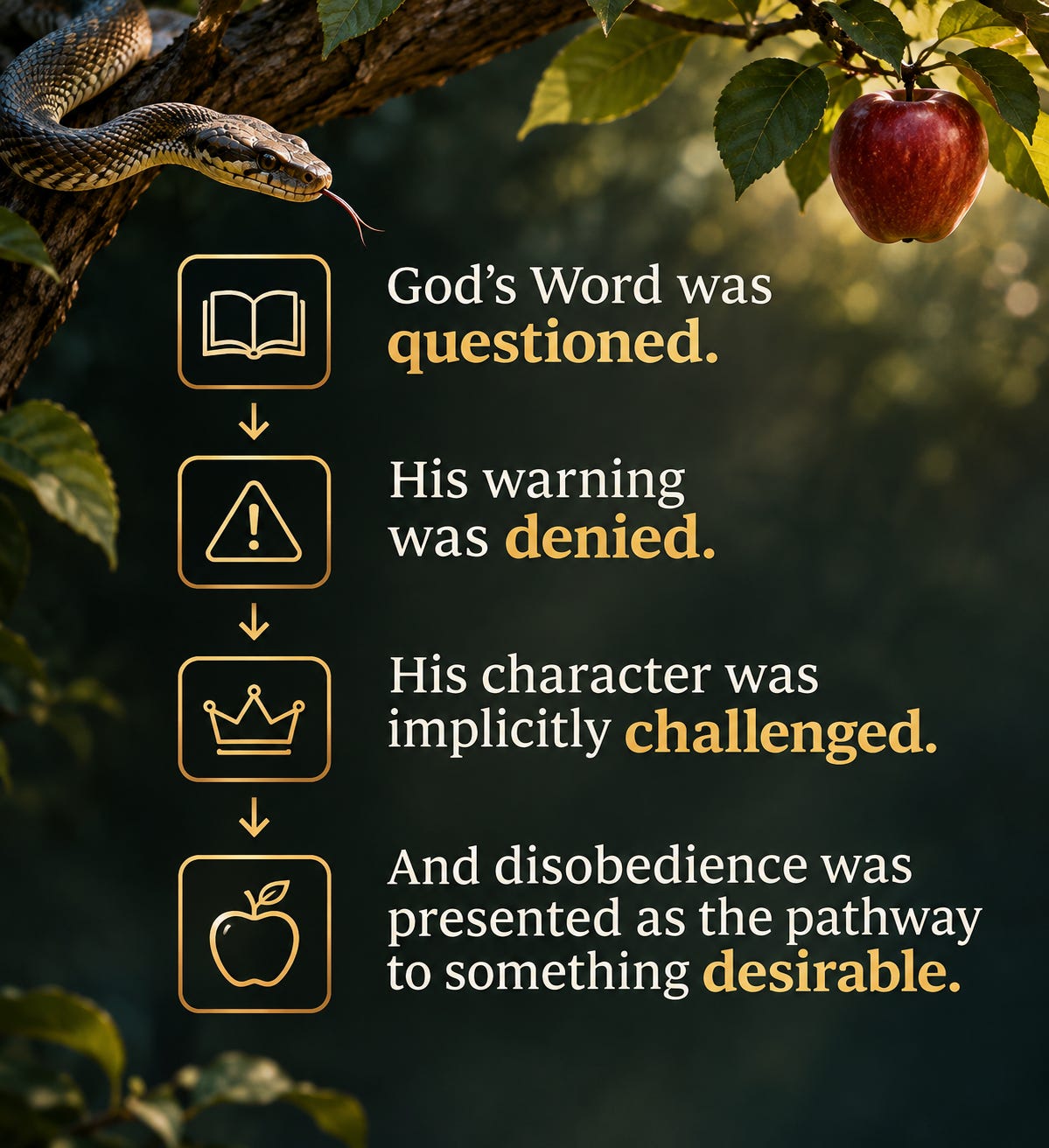
The serpent was not merely encouraging Eve to eat the forbidden fruit. He was persuading her to accept an alternative interpretation of reality—one in which God’s prohibition stood between humanity and something supposedly better. But the promised advancement produced alienation, shame, and death. And the strategy did not end in Eden.
The apostle Paul explicitly connected the serpent’s deception to the danger of accepting a distorted gospel:
“But I am afraid that as the serpent deceived Eve by his cunning, your thoughts will be led astray from a sincere and pure devotion to Christ” (2 Corinthians 11:3).
In the very next verse, Paul warns about accepting another Jesus, a different spirit, or a different gospel.
That connection is extraordinary.
Paul understood that spiritual deception does not necessarily require people to abandon religious language. It can operate by corrupting their understanding of what God has revealed.
Satan does not need to remove Jesus’ name from a religion to lead people away from Him. He only needs to corrupt what that religion teaches about sin, who Jesus is, and what His sacrifice accomplishes.
That is why doctrinal truth matters. A distorted understanding of sin can produce a distorted understanding of the Savior. And that brings us to a remarkable teaching from one of Mormonism’s most influential leaders.
2. Dallin H. Oaks: Adam Transgressed, but Did Not Sin
In his October 1993 General Conference address, The Great Plan of Happiness, Dallin H. Oaks explained the LDS understanding of Adam and Eve’s actions in the Garden of Eden. Oaks distinguished between a sin and a transgression.
He compared the difference to the distinction between something inherently immoral, such as murder, and something prohibited by law, such as operating without a license.
According to Oaks, Adam and Eve’s disobedience belonged to the second category. It was prohibited, but not inherently sinful. He described Eve’s act as “eternally a glorious necessity” and said that Adam demonstrated wisdom by following her example. In other words, Oaks is saying Adam demonstrated wisdom by disobeying God. I respectfully disagree, but hang in there.
Oaks even cited Joseph Smith’s teaching that Eve’s act was not sin because God had decreed it.
Pause and consider what is being taught.
God commanded Adam not to eat from the tree.
Adam ate from the tree.
Yet a religious leader explains that the action was not sin, but a necessary and ultimately praiseworthy step in God’s plan. That is a remarkable reinterpretation of the biblical account.
And it raises an obvious question:
If deliberately disobeying God’s explicit command is not sin, what is?
Oaks’s teaching is not an isolated remark. It reflects the broader LDS understanding of the Fall, including the Book of Mormon’s declaration in 2 Nephi 2:25:
“Adam fell that men might be; and men are, that they might have joy.”
This passage was written in 1830 in King James–style English, so its meaning is maybe a little unclear. A modern paraphrase would be:
“Adam disobeyed God so the human race could exist. And we’re here so we can experience joy.”
So again, Adam’s disobedience to God is a good thing because it allowed the human race to exist, and we’re here in this world to experience joy?
Within Mormon theology, the Fall isn’t the catastrophic cause of humanity’s separation from a Holy God, but rather a necessary step that ultimately leads towards exaltation. But … BUT, is that what the Bible teaches?
3. Scripture Settles the Question: Adam Sinned
Fortunately, we do not have to speculate about whether Adam’s disobedience was sin. The apostle Paul tells us.
Romans 5:12 declares that sin entered the world through one man, and death through sin.
Romans 5:14 identifies Adam’s act as a transgression.
Romans 5:16 explicitly describes Adam as “the one who sinned.”
The Greek word translated sinned is ἁμαρτήσαντος (hamartēsantos), from hamartanō, meaning “to sin.”
Then Romans 5:19 calls Adam’s act disobedience.
Paul uses different words to describe the same moral catastrophe: sin, transgression, trespass, and disobedience. He does not establish a special category in which violating God’s command somehow ceases to be sinful.
Adam’s transgression was sin.
This matters because Paul builds his explanation of salvation upon the contrast between Adam and Jesus Christ.
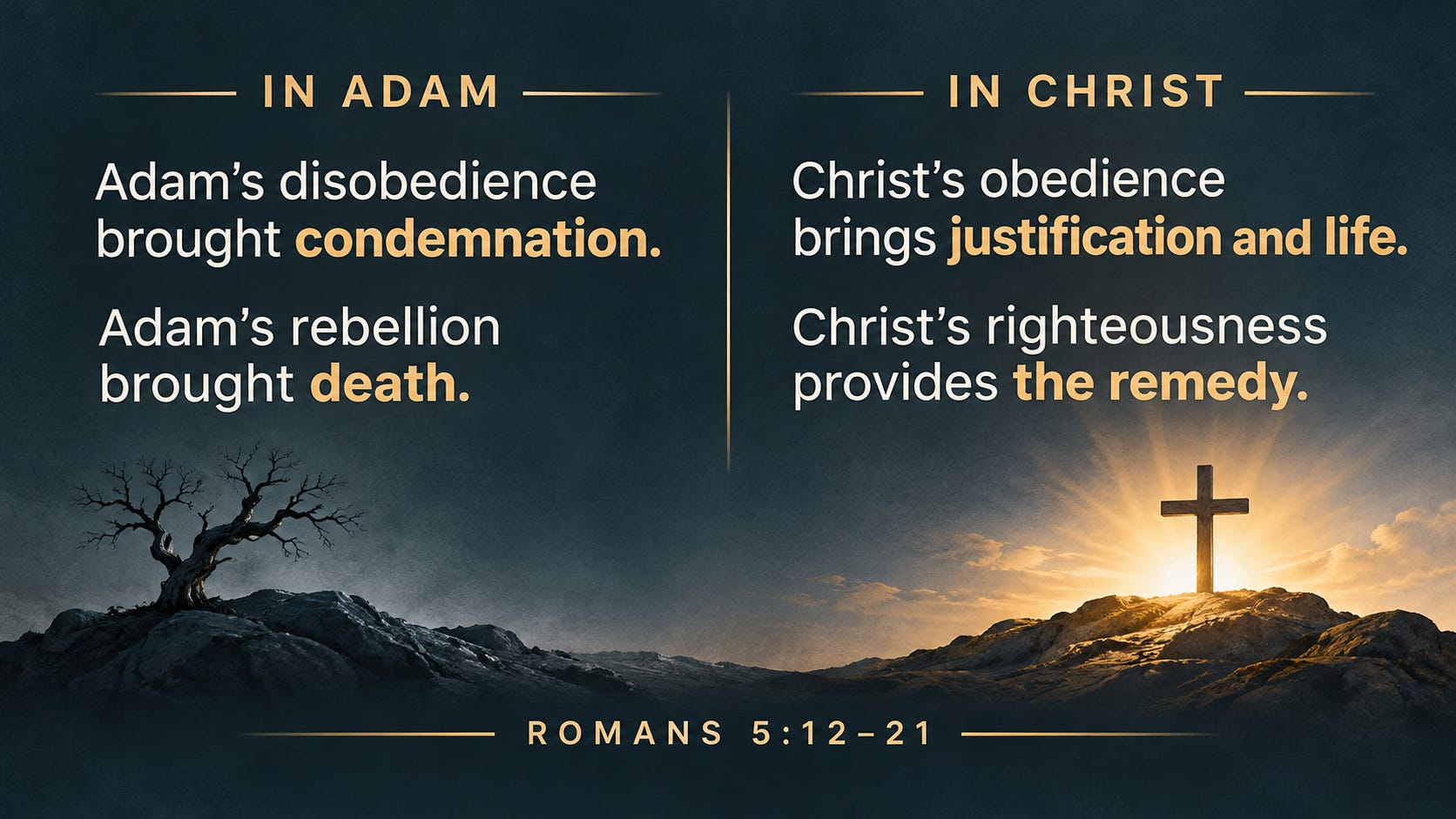
Romans 5:19 states:
“For as by the one man’s disobedience the many were made sinners, so by the one man’s obedience the many will be made righteous.”
The comparison is foundational to the gospel. If we redefine Adam’s rebellion as morally innocent, we begin altering the very problem Christ came to remedy. And that is no small matter whatsoever.
4. But, … Wasn’t the Fall Part of God’s Plan?
At this point, a Mormon missionary might raise an objection if they haven’t said yet it’s time for them to get to their next appointment.
“If God is sovereign, wasn’t Adam’s Fall part of His plan? Didn’t God know it would happen?”
Yes.
But that does not make Adam’s disobedience righteous. Christians have long debated how God’s sovereignty relates to human freedom. Calvinists emphasize God’s comprehensive decree. Arminians emphasize God’s foreknowledge and humanity’s genuine responsibility to respond freely.
Those differences matter, but neither position requires denying that Adam sinned.
In fact, both traditions historically affirm that Adam’s disobedience was sinful. Consider the crucifixion of Jesus Christ. Acts 2:23 teaches that Jesus was delivered up according to God’s definite plan and foreknowledge. Yet Peter immediately holds those responsible for His crucifixion morally accountable.
Likewise, Acts 4:27–28 explains that the enemies of Jesus carried out what God’s hand and plan had predestined to take place.
Was the crucifixion part of God’s sovereign purpose?
Absolutely.
Did that make the betrayal, injustice, and murder of Jesus morally righteous?
Absolutely not.
Or consider Joseph’s (not Smith) words to his brothers:
“As for you, you meant evil against me, but God meant it for good” (Genesis 50:20).
The same event involved wicked human intentions and God’s righteous purpose. God’s ability to accomplish good through evil does not transform evil into good. Therefore, even if Adam’s Fall occurred within God’s sovereign plan, it does not follow that Adam’s disobedience was not sin.
To argue otherwise would be to confuse God’s providence with His moral approval. And Scripture makes no such confusion.
5. From Rebellion to Exaltation: How the Goal Changes
Here is where the LDS revision, or what they might refer to as part of the “restoration,” becomes especially consequential.
Mormonism’s revision of Adam’s Fall helps reshape redemption into part of a larger system of progression toward exaltation. In the biblical account, humanity’s central problem is sin and separation from God.
We have rebelled against our Creator. We stand guilty before Him. We cannot reconcile ourselves to Him through our own righteousness. We need a Redeemer. But Mormon theology places the Fall within a broader plan in which God’s spirit children enter mortality, gain experience, receive physical bodies, and progress toward becoming like Heavenly Father, even to the point of becoming gods themselves. This is what is meant, in part, by “exaltation” in Mormonism.
Exaltation then becomes a central objective in Mormon theology.
Now consider the serpent’s original promise.
“You will be like God.”
The resemblance is difficult to ignore.
Oaks’s teaching does not reproduce every element of the serpent’s argument, and Mormonism does not formally teach that Satan was right about everything in Eden. But Oaks’s celebration of the Fall as a necessary step toward eternal progression raises a serious theological concern. The serpent, after all, presented disobedience as the pathway to becoming like God.
Oaks presents Adam and Eve’s disobedience as a necessary and ultimately wise step in the plan leading toward exaltation.
The parallel should alarm anyone who takes Genesis 3 seriously.
Biblical Christianity certainly teaches that redeemed believers will be glorified and conformed to Christ’s image (Romans 8:29-30; 1 John 3:2). But becoming like Christ in holiness and glory is not the same as progressing toward the kind of godhood taught in LDS theology.
The distinction between Creator and creature remains. The biblical goal is not to become another God. It is to be reconciled to the one true God through Jesus Christ, to represent Him in this life now (2 Corinthians 5:18-20).
6. If Jesus Paid for Sin, Why Isn’t Jesus Enough?
Ask a Mormon missionary whether Jesus Christ’s Atonement is necessary for salvation, and you will almost certainly hear an enthusiastic, “Yes!”
Good. But ask a second question.
What exactly did His Atonement accomplish?
You may hear that Jesus suffered and died so our sins could be forgiven. Again, sounds biblical.
But keep asking questions.
If Christ has accomplished everything necessary to reconcile sinners to God, why does LDS theology require baptism performed through recognized priesthood authority? Why are temple ordinances necessary for exaltation? Why must individuals receive and remain faithful to particular covenants to obtain the highest promised blessings? And why can these ordinances be performed by living people on behalf of the dead?
These are not imaginary requirements invented by critics.
The LDS Church’s own General Handbook identifies baptism, confirmation, priesthood ordination, the temple endowment, and temple sealing as ordinances necessary for salvation and exaltation.
Its teaching on proxy baptism allows deceased individuals to accept or reject ordinances performed on their behalf. The LDS Church explicitly teaches that Christ’s Atonement makes resurrection and forgiveness possible. That is an important fact.
But it really is a genuine bait-and-switch.
While Mormonism (aka “the Church of Jesus Christ of Latter-Day Saints,” in case you’ve forgotten) says Jesus’s death-sacrifice is for the payment of our sins and for resurrection, when pressed on whether simply believing in this is enough to enter into God’s presence once one dies, they most often confess that one needs to be baptized in a particular place by a particular person in a particular manner first.
More specifically, Mormon teaching separates salvation, which requires baptism and confirmation to enter the celestial kingdom, from exaltation, which also requires the endowment and sealing.
The question, nonetheless, is not whether Mormonism mentions Christ’s Atonement. The question is whether its account of salvation aligns with the apostolic witness’s proclamation of the sufficiency of Christ’s finished work.
The Bible says:
“For we hold that one is justified by faith apart from works of the law” (Romans 3:28).
Ephesians 2:8-10 teaches that salvation is God’s gift, not the result of works, and that good works follow as the fruit of being created anew in Christ.
Hebrews 10:14 declares:
“For by a single offering he has perfected for all time those who are being sanctified.”
Notice the order:
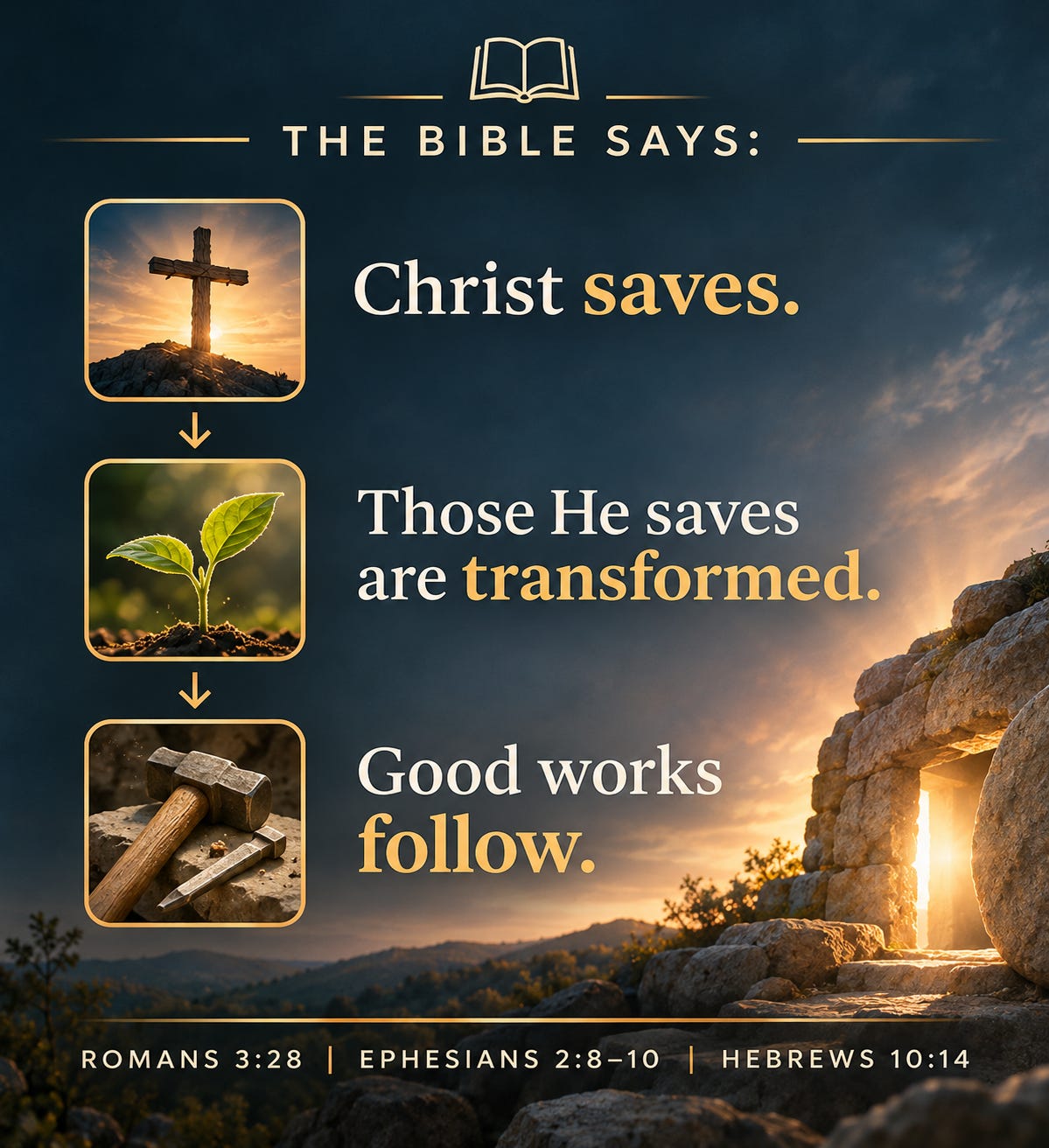
Obedience matters deeply. Baptism matters. Repentance matters. Perseverance matters.
But none of these can replace or supplement the sufficiency of Christ’s sacrifice as the ground of our justification before God.
The New Testament never teaches that sinners must obtain temple endowments, marriage sealings, or priesthood authorization from a restored nineteenth-century institution to receive the fullness of eternal life in Christ as Mormonism mistakenly espouses.
The biblical gospel directs our confidence toward the Redeemer Himself.
Not toward a ladder of religious advancement.
Not toward a temple ceremony.
Not toward eventual godhood.
Toward Jesus Christ.
7. “But I Prayed About It, and the Holy Spirit Told Me It’s True”
If you have spent much time discussing Scripture with Mormons, you recognize this response. After examining a difficult biblical passage, the conversation sometimes shifts away from the text.
“I know the Church (of Mormonism/Latter-Day Saints) is true.”
“I prayed about the Book of Mormon, and the Spirit confirmed it in me that it is true.”
“The Holy Ghost confirmed it to me.”
I do not doubt that many Mormons sincerely believe they have experienced something spiritual. But sincerity does not establish truth.
People belonging to mutually contradictory religions can describe powerful spiritual experiences. Those experiences cannot all establish contradictory theological claims as equally true.
So how should we evaluate them?
Scripture tells us.
First John 4:1 commands believers not to believe every spirit, but to test the spirits to determine whether they are from God. Acts 17:11 commends the Bereans because they examined the Scriptures daily to determine whether Paul’s teaching was true. And Galatians 1:8-9 provides an especially sobering warning.
But even if we or an angel from heaven should preach a gospel other than the one we preached to you, let them be under God’s curse! 9 As we have already said, so now I say again: If anybody is preaching to you a gospel other than what you accepted, let them be under God’s curse!
Even an angel.
That should settle the question of whether an extraordinary spiritual experience can establish the truth of a contradictory gospel.
It cannot.
A missionary may respond, “But I know the Holy Spirit confirmed it.”
Then I ask:
Would the Holy Spirit confirm a teaching that contradicts what He has already revealed through the apostles?
The biblical answer is no. The Spirit of truth does not contradict Himself. And our subjective impressions do not get equal or greater merit than God’s revealed Word.
Prayer is good. Seeking God’s guidance is good. But praying about a claim does not relieve us of the responsibility to examine whether that claim is true.
If a religious leader teaches that Adam did not sin, while God’s Word explicitly calls Adam the one who sinned, the appropriate response is not to dismiss God’s Word because of a personal testimony.
It is to reconsider the religious leader’s teaching.
The issue is not whether your feelings are genuine. The issue is whether your conclusion is true.
8. False Teaching Is Not Harmless
Some may object to calling a doctrine heretical. They may consider the language confrontational. But the apostles did not treat every theological disagreement as simply harmless. Paul warned against another gospel (Galatians 1:6-9) as previously referenced.
Peter warned about false teachers introducing destructive heresies (2 Peter 2:1). Jude urged believers to contend for the faith once delivered to the saints (Jude 3). And Jesus Himself issued severe warnings against religious leaders who misled others (Matthew 23).
We should distinguish between those who teach serious error and those who have inherited that teaching without examining it.
A young Mormon missionary may sincerely desire to honor God while repeating doctrines learned from having been born in a Mormon bubble so to speak, from those like family and teachers they naturally trust and admire.
That sincerity deserves to be treated with gentleness.
But the doctrine itself must still be tested. Dallin H. Oaks bears responsibility for his public teaching about Adam’s Fall. His religious position does not exempt his statements from biblical testing; as a leader in a religion that says it believes in the Bible, his comments must be tested by Scripture.
And when his teaching conflicts with the Bible’s explicit identification of Adam’s sin, Christians have a responsibility to say so.
Within the biblical framework of spiritual warfare, this is not merely an academic dispute. Second Corinthians 11 warns that Satan disguises himself as an angel of light and that false apostles can present themselves as servants of righteousness.
This requires us to recognize that false teaching has devastating spiritual consequences, even when it is presented in religious language.
The danger is not always a religion that openly rejects Jesus.
Sometimes it is a religion that uses His name while changing the meaning of His identity, His mission, and His saving work.
9. The Most Frightening Words a Religious Person Could Hear
Jesus gave a warning that should concern every professing Christian. In Matthew 7:21-23, He describes people who call Him Lord and point to remarkable religious accomplishments performed in His name.
Yet He tells them:
“I never knew you; depart from me, you workers of lawlessness.”
Think about that.
Think about that!
These people were religious. They knew Jesus’ name. They believed their activities demonstrated devotion to Him. But religious activity did not establish that they belonged to Christ. This warning is not exclusively for Mormons. It is for everyone who professes to follow Jesus.
We must never confuse religious confidence with saving faith. And we must never assume that familiarity with Christian vocabulary guarantees that we understand the Christian gospel.
To the Mormon missionary reading this, I want to ask you something personally.
What are you ultimately trusting to make you right with God?
Is it the completed work of Jesus Christ?
Or is it a religious system that promises exaltation through priesthood authority, ordinances, temple covenants, and continued progression?
Have you considered the possibility that a teaching you received from a respected leader could be wrong?
Have you examined Romans 5 carefully enough to recognize that Paul calls Adam’s disobedience sin?
And have you considered why a doctrine that denies the sinful character of Adam’s original rebellion should be accepted when Scripture teaches otherwise?
These questions matter because your eternal destiny matters. The serpent’s promise in Eden was that disobedience would lead humanity toward becoming like God. The gospel announces something infinitely greater.
God the Son became man, lived in perfect obedience, died for sinners, and rose bodily from the grave so that those who trust in Him might be reconciled to God.
The answer to Adam’s sin is not humanity’s exaltation to godhood. It is the obedience and sacrifice of Jesus Christ. The answer to our guilt is not a system of ordinances. It is the Redeemer who bore our sins. And the answer to our spiritual death is not religious progression. It is the risen Savior who gives eternal life.
Jesus declared:
“I am the way, and the truth, and the life. No one comes to the Father except through me” (John 14:6).
He did not say that He was merely the beginning of a pathway to becoming gods.

Excellent!