

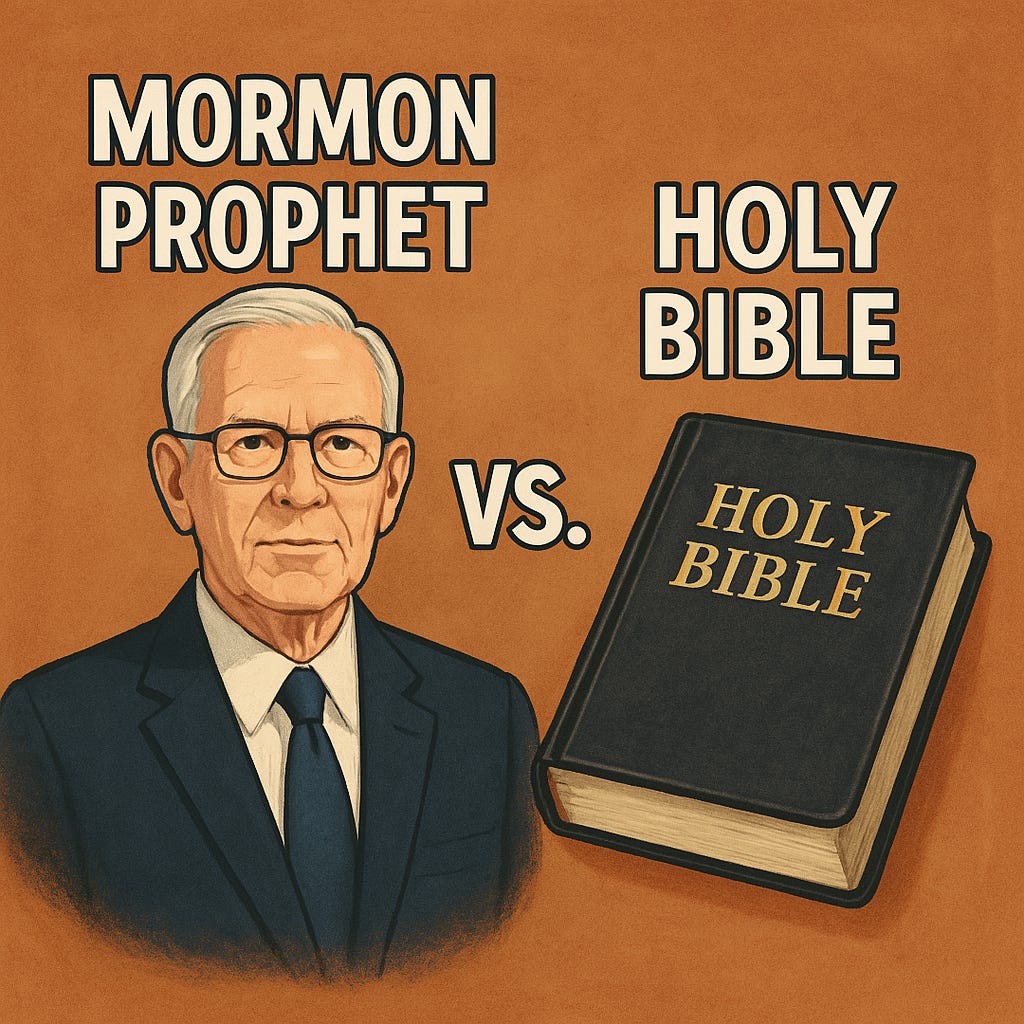
Let me put it bluntly: if a man in Salt Lake claims to speak with the same authority as Isaiah or Paul, he’d better come packing plagues or predictive prophecy that’s 100% accurate — no “if, maybe, spirit of revelation” loopholes.
Why?
Because the Bible doesn’t allow for “kinda-sorta” prophets.
In Deuteronomy 18:20–22, the test is clear:
“But the prophet who presumes to speak a word in My name that I have not commanded him to speak… that same prophet shall die.”
“If the thing does not come to pass or come true, that is a word that the Lord has not spoken…”
Latter-day Saints often nod their heads here and say, “Exactly! That’s how you know someone’s a false prophet!” — and they’re right, in theory.
But in practice, they conveniently shelve this test when it comes to Joseph Smith and his successors.
Let’s be honest: Apply Deuteronomy 18 today, and half the so-called prophets would be out of the revelation business and into something safer, like weather forecasting.
Smith predicted the coming of the Lord before 1891[^1], the construction of a temple in Missouri within a generation[^2], and that certain men would live to see these things fulfilled[^3]—none of which happened.
If even one of these fails, he fails the test.
And here's the kicker: Deuteronomy 18 doesn’t say, “If it *usually* comes to pass…” or “If it’s *spiritually* fulfilled…” It says, *“If the thing does not come to pass.”
Hebrew: דָּבָר לֹא יִהְיֶה (davar lo yihyeh) — "the thing does not occur."
Not “the feeling wasn’t right” or “it was fulfilled symbolically later.” This is plain, unambiguous criteria.
So while LDS apologists affirm the principle, they deny its application, because applying it honestly disqualifies the very foundation of their prophetic succession.
God doesn’t grade prophecy on a curve. It’s not “mostly true,” it’s flawless or false, 100%. All the time.
Every. Single. Time.
Contrast this with LDS prophets, whose revelations have repeatedly required retroactive clarification, reversal, or quiet retirement.
That's not “navi” (נָבִיא)— the Hebrew word for prophet, meaning one who proclaims the authoritative, infallible Word of the Lord.
That’s more like a spiritual pundit with poor reception.
In the New Testament, prophecy shifts.
Hebrews 1:1–2 declares a seismic transition:
“Long ago, at many times and in many ways, God spoke to our fathers by the prophets, but in these last days he has spoken to us by His Son…”
Jesus is not the warm-up act.
He’s the final Word, the “Logos” (λόγος), God’s ultimate revelation. The canon is closed because the curtain has been torn.
No sequel needed.
Let’s be honest. I can’t even predict if I’ll stick to my diet tomorrow, let alone declare “Yea, verily, saith the Lord…” with the weight of eternal consequence. Neither can your bishop.
LDS theology cleverly sidesteps the biblical test of the prophet by redefining prophecy itself. That’s like avoiding a DNA test by saying, “Well, we don’t do genetics that way.” It’s a self-serving dodge that conveniently enables ongoing revelation contrary to Jude 3, which says the faith has already been “once for all delivered to the saints.”
The implication is staggering: if LDS prophets are truly on par with Moses or Paul, then we must treat their words as Scripture. But to do so requires reopening the canon, a move the historic Christian Church, East and West, rejected unanimously for nearly two millennia.
A Bible with an open canon is a Bible with a hole in its hull. It can’t be our final authority if it’s still under revision.
To those in the LDS Church, I say this with sincerity and without condescension: you’ve been taught that modern prophets are God’s gift. But when tested against the standard God Himself set, they come up short. Not because you’re naïve but because the system isn’t biblical. And I believe the same Jesus you say you honor from the Bible wants you to know Him in truth, the way He’s revealed Himself: once, for all, in the pages of the Holy Bible.
Not in Utah. In Christ alone.
Footnotes
[^1]: *Doctrine and Covenants* 130:14–17 — Joseph Smith reports being told by God that if he lived to 85, he would see the Second Coming. He later said, “I believe the coming of the Son of Man will not be any sooner than that time.” Smith was killed in 1844, aged 38.
[^2]: *Doctrine and Covenants* 84:1–5 — Smith prophesied a temple would be built in Jackson County, Missouri “in this generation.” That temple was never built, and the land is now owned by the Church of Christ (Temple Lot).
[^3]: *History of the Church*, Vol. 2, p. 182 — Smith prophesied that several people standing before him would not die before Jesus returned. All of them are now dead.
A Final Word to My LDS Friends
If you've made it this far, thank you. I don’t take your time—or your convictions—lightly.
My aim in writing this isn't to win an argument or to mock your faith, but to appeal to your conscience and your commitment to truth. My deepest concern is that what you’ve been taught about God, Scripture, and salvation is built on interpretations that cannot stand under the weight of careful, biblical exegesis.
I urge you: test every spirit. Don’t just follow tradition or emotion—let the Word of God be your foundation. If what Joseph Smith claimed is true, it will stand up to the full scrutiny of Scripture. But if it isn’t, then eternity is too high a price to pay for misplaced trust.
Grace and truth are not enemies. My hope is that you’ll search the Scriptures afresh—not through the lens of post-biblical revelations, but through the inspired, sufficient Word of God.
In Christ’s love,
Rob Alsobrook
🙏 Help Keep This Work Going
If this article helped clarify your understanding of Scripture — or helped you share truth with someone in the LDS church — consider sharing it.
You can also support this publication by subscribing, commenting, or becoming a paid supporter to help keep content like this going.
🌱 This mission doesn’t run on good intentions alone (though we have plenty).
🙌 It runs on prayer, provision, and people like you.
🤝 Every gift you give goes directly to gospel work: evangelism, discipleship, biblical teaching, and loving people well in places where the Church is barely visible — or completely absent.
❤️ So, if you've ever wanted to be part of something eternal without moving to the other side of the world or giving up coffee, here's your chance.
💡 Join us in the Great Commission — because planting, watering, and harvesting the Word of God takes all kinds of hands.