


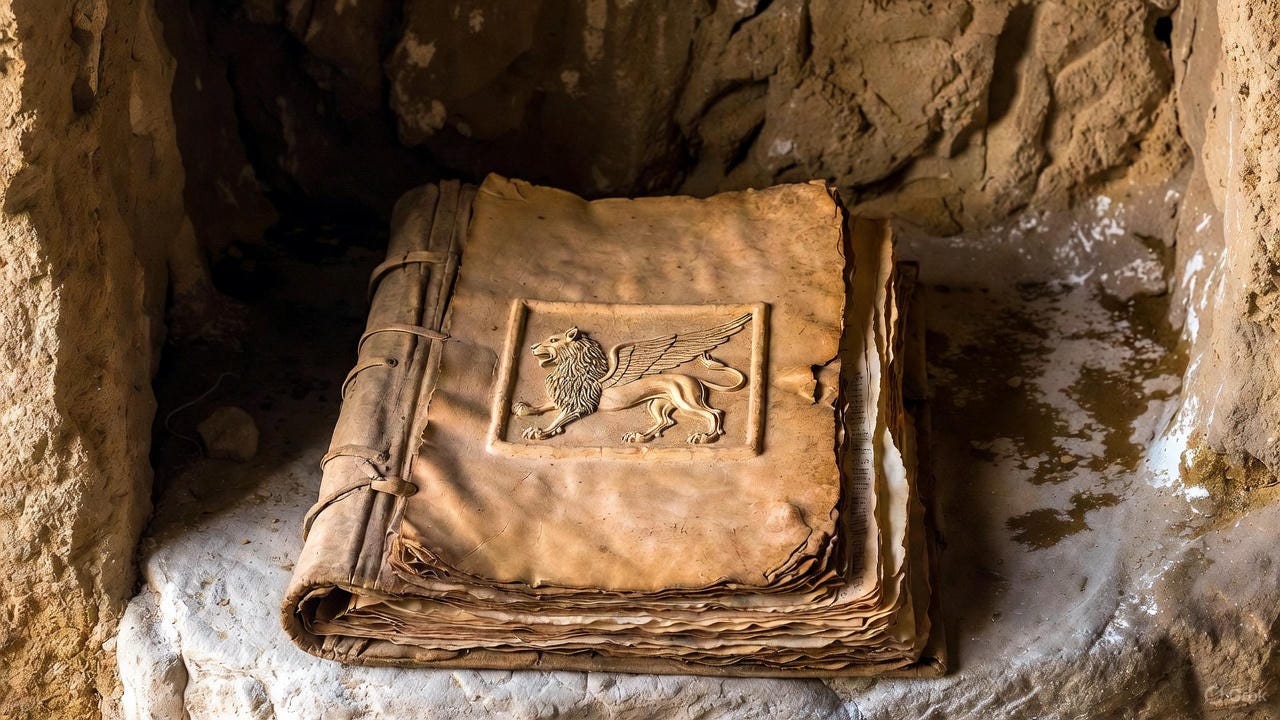
The Gospel of Mark hits like a sprint. Short, breathless, and relentless, it drags the reader straight into the dust and chaos of Galilee with the words, “The beginning of the gospel of Jesus Christ, the Son of God” (Mark 1:1 ESV). No infancy stories, no genealogy——just the roar of a lion breaking into a world held captive by sin, Satan, and death.
Mark presents Jesus as the mighty Son of God who storms the strong man’s house (Mk 3:27), yet the path to His crown runs straight through a Roman cross. This is the paradox at the heart of the Gospel: the all-powerful Messiah wins by losing, reigns by serving, and conquers by dying.
This article surveys Mark’s authorship and date, its breathless style and structure, the dominant theme of the kingdom arriving through suffering, the motif of the Messianic Secret, the discipleship failures that frame the story, and the Gospel’s urgent call to follow this crucified King today. While acknowledging scholarly debates (especially around date and the abrupt ending at 16:8), the article defends the positions most consistent with early church tradition and the text’s internal evidence.
Authorship and Setting
From the second century onward, the early Christian tradition, uncontested in antiquity, identifies the author as John Mark——not one of the Twelve, but the young man who fled naked at Jesus’ arrest (14:51–52), the cousin of Barnabas, the sometime traveling companion of Paul, and, most importantly, Peter’s “interpreter” (hermēneutēs) in Rome.¹
The earliest church fathers like Papias (c. 130, quoted in Eusebius, Hist. eccl. 3.39.15), Clement of Alexandria, Irenaeus, Tertullian, and Origen all agree: Mark wrote down what he heard from Peter, not in chronological order but as Peter preached it.² No ancient source ever attributes the Gospel to anyone else. None.
Most likely composed in Rome for a Gentile-Christian (or mixed) audience facing persecution under Nero in the mid-to-late 60s AD, Mark explains Jewish customs (7:3–4), translates Aramaic phrases (5:41; 15:34), and sprinkles in Latin loanwords.³ A pre-70 date fits the urgent expectation of suffering, the absence of any reflection on Jerusalem’s destruction, and the tradition that Peter and Paul were martyred in Rome around 64–67.⁴
One Word: Immediately
Mark’s favorite word is εὐθύς or εὐθέως—“immediately” or “at once”—appearing over forty times (more than all the other Gospels combined). The effect is cinematic: Jesus strides from miracle to miracle, from confrontation to confrontation, always driving the story forward with ferocious, passionate, purpose-driven energy.
Roughly 27 percent of the Gospel of Mark consists of miracle stories, more than any other Gospel.⁵ Demons shriek, storms obey, the dead rise, and the narrator never lets the reader catch their breath.
This is not a leisurely biography; it is an apocalyptic war report.
Structure That Serves the Drama
Mark divides neatly into two dramatic acts, pivoting at the great confession in Caesarea Philippi:
Chapters 1–8: Who is Jesus? Galilee explodes with authority—over demons, disease, nature, and sin. Peter finally blurts out the answer: “You are the Christ” (8:29).
Chapters 8:31–16:8: How will He become King? Three times Jesus predicts His passion (8:31; 9:31; 10:33–34). Three times the disciples spectacularly miss the point. The road to Jerusalem is a slow, deliberate march to the cross. The king will reign—from a tree. Not by consequence, but by choice.
The geographical shift from Galilee to Jerusalem mirrors the theological shift from power to weakness, from glory to shame, from triumph to apparent defeat——followed by the greatest reversal of all: an empty tomb and a promise that the risen Lion will meet His followers in Galilee (16:7).
(Pardon the disruption, but if this kind of biblical, Christ-centered writing strengthens your faith, would you prayerfully consider supporting Docilitas by clicking the button so more people can encounter Jesus and His Word with clarity and conviction?)
A Kingdom Won Through Suffering
Mark refuses to let us domesticate Jesus. He is the stronger man who binds Satan (3:27), the Bridegroom who will be taken away (2:19–20), the Son of Man who must suffer and rise (8:31), the ransom for many (10:45).
The cross is not Plan B; it is the very means by which the kingdom breaks in. Every miracle is a preview of the final exorcism and resurrection that will happen when the Son of Man returns in glory (13:26; 14:62).
The Messianic Secret and the Disciples’ Blindness
Jesus repeatedly commands silence after miracles and even after Peter’s confession (8:30). Why? Because Israel, and even the Twelve apostles, expect a warrior-king who crushes Rome, not a Servant-King who lets Rome crush Him. Until the cross and resurrection are seen together, any proclamation of “Messiah” will be fatally misunderstood.⁶
Mark’s disciples are Exhibit A: ambitious, cowardly, thick-headed, and finally deserters. Yet the Gospel ends with the promise that the risen Jesus will restore them anyway (14:28; 16:7).⁷
Grace triumphs over failure.
What Mark Demands of Us Today
Mark will not let us stand on the sidelines as curious spectators. The same voice that hushed the sea still thunders, “Why are you so afraid? Have you still no faith?” (4:40). The same crucified King who rose on the first day of the week now demands, “If anyone would come after me, let him deny himself and take up his cross and follow me” (8:34).
This Gospel was written for frightened Roman believers facing the lions in the arena.
It is written for us in a world that still mocks weakness and crucifies servanthood. Mark’s final word (in the earliest manuscripts) is the women fleeing the tomb in terror and amazement (16:8). The story feels unfinished——because it is not. The risen Jesus is still on the move, still meeting failed disciples in Galilee, still calling cowards to become witnesses.
The question Mark hurls at every reader is brutal and unavoidable:
When you finally see this bleeding, risen King for who He is——what will you do? Will you keep silent out of fear, or will you go and tell?
Mark leaves us standing at a doorway—with the stone rolled back, and a choice to make.
Footnotes
¹ Andreas J. Köstenberger, L. Scott Kellum, and Charles L. Quarles, The Cradle, the Cross, and the Crown, 2nd ed. (Nashville: B&H Academic, 2016), 277–278.
² Eusebius, Hist. eccl. 3.39.15 (Papias); summary in Köstenberger, Kellum, and Quarles, Cradle, Cross, Crown, 277.
³ Patrick Schreiner, The Four Gospels: Jesus, the Hope of the World (Nashville: B&H Academic, 2024), 70–72.
⁴ R. T. France, The Gospel of Mark, NIGTC (Grand Rapids: Eerdmans, 2002), 33–41; Schreiner, The Four Gospels, 70–72.
⁵ Patrick Schreiner, The Visual Word: Illustrated Outlines of the New Testament Books (Chicago: Moody, 2021), 22–24.
⁶ Classic treatments of the Messianic Secret: William Wrede (1901) and later refinements by France, Mark, 11–16.
⁷ On discipleship failure as a deliberate Markan theme, see Elizabeth Struthers Malbon, Mark’s Jesus: Characterization as Narrative Christology (Waco: Baylor University Press, 2014).
Bibliography
France, R. T. The Gospel of Mark. NIGTC. Grand Rapids: Eerdmans, 2002.
Köstenberger, Andreas J., L. Scott Kellum, and Charles L. Quarles. The Cradle, the Cross, and the Crown. 2nd ed. Nashville: B&H Academic, 2016.
Schreiner, Patrick. The Four Gospels: Jesus, the Hope of the World. Nashville: B&H Academic, 2024.
Schreiner, Patrick. The Visual Word: Illustrated Outlines of the New Testament Books. Chicago: Moody, 2021.