
“And call no man your father on earth, for you have one Father, who is in heaven.”
— Jesus, Matthew 23:9 (ESV)
A Word from Jesus That Still Confronts Us
When Jesus said, “Call no man your father on earth,” He wasn’t outlawing Father’s Day. He was confronting a system where religious elites elevated themselves above others, positioning themselves as spiritual gatekeepers.
The Greek word for “call” (kaleō) implies authoritative naming, assigning power or status. And “father” (pater) in this context isn’t about biology, it refers to spiritual authority and religious hierarchy.
Jesus was challenging the very structures that made spiritual leaders into intermediaries between God and people. He pointed to a better way:
You have one Father — and He’s in heaven.
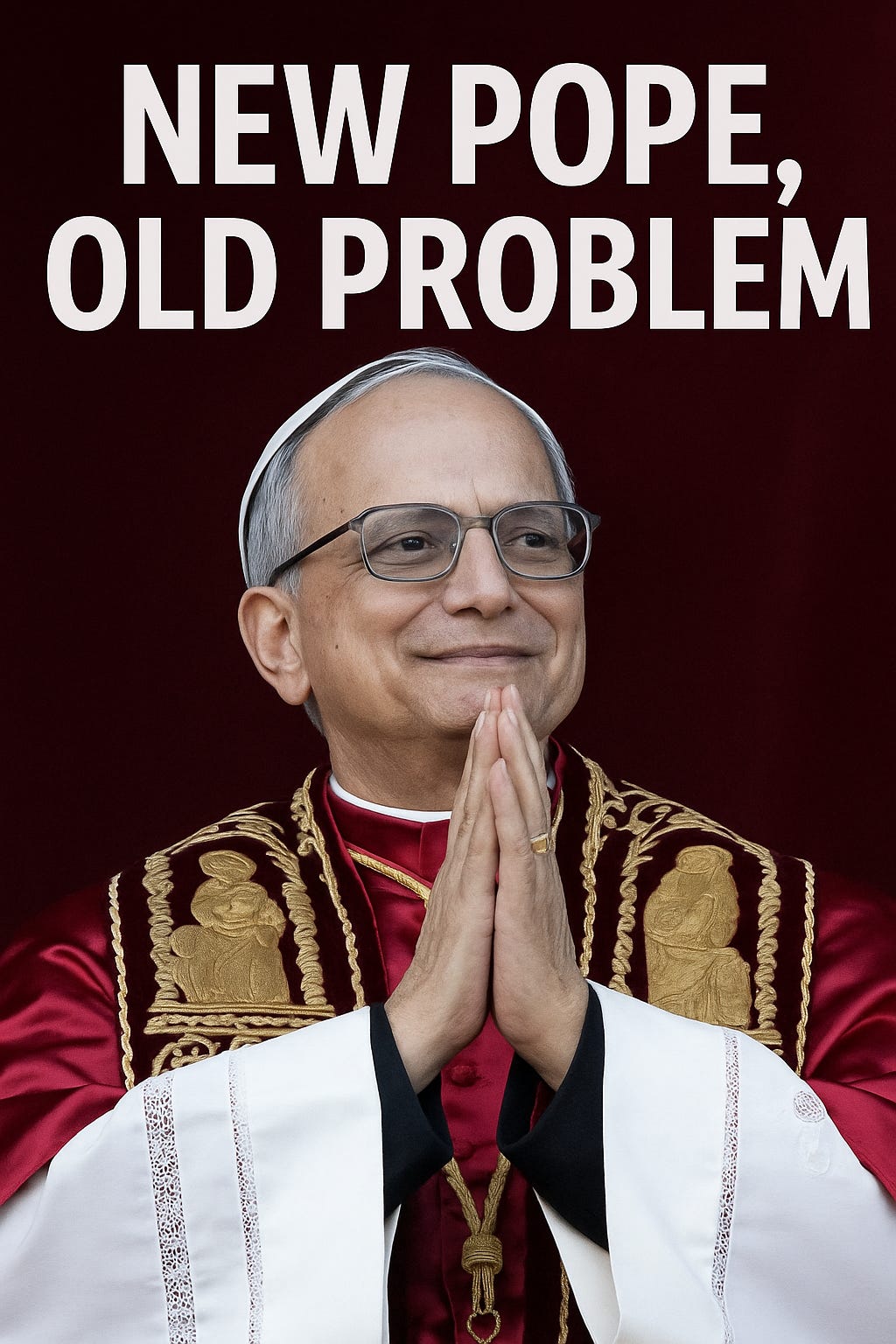
Today, the Catholic faith celebrates the election of a new pope, a man millions will call “Holy Father,” regarded as the Vicar of Christ and the visible head of their worldview. But in light of Jesus’ words, this practice invites a serious question:
Have we again institutionalized what Jesus came to undo?
“It’s Just a Title”... Is It?
Some Catholic readers may respond, “Jesus was using hyperbole. After all, Paul called himself a spiritual father in 1 Corinthians 4:15.”
It’s true, Jesus did sometimes use exaggeration to make a point. But this wasn’t mere rhetoric; it was part of a rebuke of religious leaders who “love to be called rabbi... and father” (Matt. 23:6–9). He wasn't banning the word "father" in every context. He was targeting men with spiritual titles who exalt themselves above others and obscure, and hinder, access to God.
When Paul called himself a “father” to the Corinthians, it was relational, not hierarchical. He never demanded the title or office of “Holy Father.” And he certainly never claimed infallibility.
To be fair, Catholics do not teach that the pope is infallible in everything he says or does. Rather, the official doctrine defined at Vatican I in 1870 holds that the pope is infallible only when speaking ex cathedra (“from the chair”), specifically on matters of faith and morals, with the intent of binding the entire Church.
Even so, this belief that a man can speak without error on behalf of God is without precedent in the New Testament.
Not once do we see Peter or Paul declare their teaching as irreformable by virtue of their office. In fact, Paul corrects Peter publicly (Galatians 2:11), and Peter calls himself a "fellow elder" (1 Peter 5:1)—a peer, not a pope.
The same Paul who wrote most of the New Testament said of himself: “I am the least of the apostles” (1 Cor. 15:9).
The Catholic pope, however, is not merely a mentor. He is given titles and powers that far exceed the humility of New Testament leadership: Holy Father, Supreme Pontiff, Vicar of Christ. This is more than metaphor, it is the machinery of religious exaltation Jesus warned about.
“But Didn’t Jesus Make Peter the First Pope?”
This is perhaps the most commonly cited defense: “You are Peter, and on this rock I will build my church…” (Matt. 16:18). Catholic tradition teaches that Peter was the first pope and that apostolic succession extends from him.
But this interpretation deserves scrutiny and most definitely, exegesis:
Jesus calls Peter “rock,” but uses two Greek words: Petros (a movable stone) and petra (bedrock). The “rock” may refer not to Peter personally but to his confession that Jesus is the Christ (v. 16).
In the same chapter, Jesus rebukes Peter as “Satan” (v. 23). Hardly an endorsement of infallibility.
In Acts 15, the Jerusalem Council is led by James, not Peter.
In Galatians 2, Paul publicly rebukes Peter for his hypocrisy—again, not the behavior of a supreme, unquestioned, infallible authority.
Even more telling, Peter himself never claims supremacy. In 1 Peter 5:1, he writes, “I exhort the elders among you, as a fellow elder…” That’s the language of humility, not hierarchy.
“But the Church Gave You the Bible”
Another Catholic response is that their church, not Scripture alone, is our authority. “After all,” they say, “the Catholic Church compiled the Bible. You wouldn’t even have it without us.”
Let’s acknowledge an important point: God used faithful Christians in history to recognize the canon of Scripture. But that’s different from saying the Catholic institution created it. The Bible is not authorized by the church; the church is authorized by the Bible.
Scripture itself claims divine origin: “All Scripture is breathed out by God” (2 Tim. 3:16). It wasn’t made authoritative by councils, it was recognized because it already was.
Jesus consistently appeals to Scripture to correct tradition (Mark 7:6–13). He rebukes leaders for adding to God’s Word and binding people with commands God never gave.
That’s the concern here: Rome doesn’t just preserve tradition, it elevates it to the same level as Scripture, even when it contradicts it.
“Sola Scriptura Causes Division But We Have Unity”
Some Catholics will point to the myriad of Protestant denominations as evidence that sola Scriptura leads to doctrinal chaos, while Catholicism remains unified under the pope.
But institutional unity is not the same as spiritual unity. Rome may look unified, but internal divisions abound — traditionalists, modernists, liberation theologians, Marian maximalists, LGBT affirming activists, and more.
Biblical unity is not manufactured through bureaucracy, it is rooted in the truth of Christ (John 17:17). The early church had “one faith, one Lord, one baptism” (Eph. 4:5), not one bureaucratic empire.
An Invitation, Not an Attack
If you're Catholic and reading this, my concern is genuine: this isn’t a hit piece.
I’m not trying to tear down your reverence for God. I’m asking whether the system you trust has, in places, replaced God’s voice with man’s traditions. Whether the Jesus of the Bible has been crowded out by ceremony, saints, and sacraments.
Jesus doesn’t ask you to come through a pope. He doesn't require Latin or incense. He doesn't need a gilded throne in Rome.
He is risen.
He is near.
He invites you to come directly to Him:
“Come to Me, all who are weary and burdened, and I will give you rest.”
— Matthew 11:28
You don’t need another mediator. You already have one (1 Tim. 2:5).
You don’t need another father. You already have the best one (Matt. 23:9).
You don’t need another gospel. You already have the true one (Gal. 1:6–9).
No system, no title, no tradition can substitute for knowing Jesus Christ personally. He doesn’t ask for ceremony. He asks for your heart. He’s not waiting in a cathedral. He’s already near—speaking through His Word, calling you to Himself.
If you’ve grown up hearing about God through layers of tradition, perhaps it’s time to meet Him in His own words—open your Bible, and let Him speak for Himself.
This isn’t about leaving a religion.
It’s about finding a Savior.
And the door is still open.
Want more reflections like this?
Subscribe to The Docilitas Experience and join the conversation as we seek clarity, conviction, and Christ—through Scripture alone.