


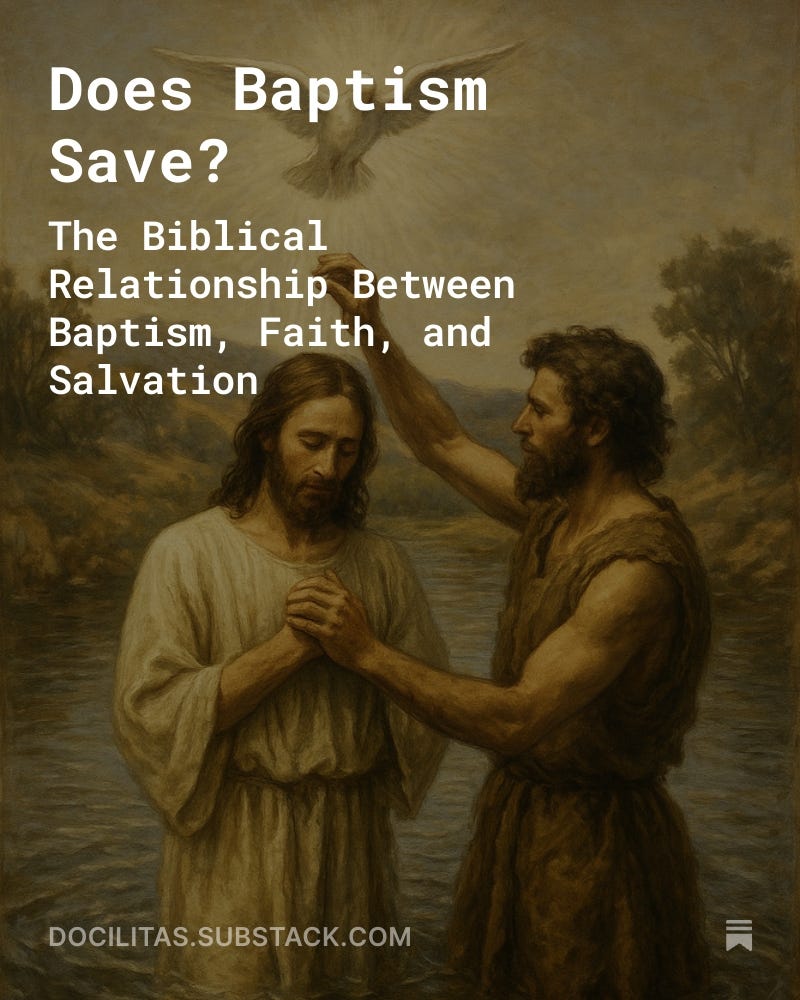
Few doctrines in the Christian faith generate as much debate as the relationship between baptism and salvation. Must one be baptized to be saved? Or is baptism the sign of salvation already received solely by grace through faith? This is no minor topic. Many a theologians since the earliest days of the church have contemplated, wrestled and debated this issue.
While some traditions hold to baptismal regeneration (the view that baptism itself is the instrument by which God imparts salvation) the historic evangelical position has been that baptism is a result of regeneration, not a step in the regenerative process.
This article will (1) examine key biblical passages often cited in support of baptismal regeneration, (2) present an exegetical case for salvation by faith alone, with baptism as a necessary command and response, and (3) apply these truths sincerely, urging both clarity in doctrine and obedience in practice.
Regeneration in Scripture
The English word regeneration translates the Greek παλιγγενεσία (palingenesia), meaning “birth again” or “new beginning.” The New Testament uses the word in two contexts:
In Matthew 19:28, Jesus applies palingenesia to cosmic renewal—“the renewal of all things” when He returns to establish His kingdom.
In Titus 3:5, Paul applies palingenesia to personal renewal—“He saved us… by the washing of regeneration (loutrou palingenesias) and renewal of the Holy Spirit.”
The same word stretches from the vast renewal of creation to the intimate renewal of the human heart. Thus, regeneration is fundamentally a work of God, accomplished through the Spirit, never reduced to a human ritual.
Biblical Texts Often Cited
Mark 16:16
Jesus declares: “Whoever believes and is baptized will be saved, but whoever does not believe will be condemned.”
The asymmetry of the clauses is crucial. The positive side stacks what normally goes together (faith and baptism). The negative side pares it down to what is essential: unbelief. Condemnation rests on unbelief (apistēsas), not on lack of baptism.
Christian rhetoricians like Stephen E. Runge point out how Greek authors frequently use negation not just to deny, but to heighten what remains shifting the reader’s focus to the essential truth (Teaching Them What NOT to Do, Runge. logos.com).
Had Jesus meant baptism as a condition for salvation, He would have said, “Whoever does not believe and is not baptized will be condemned.” But He did not. The emphasis falls on faith. Scholars of Greek rhetoric note that such asymmetry is deliberate: the positive phrase shows what is typical; the negative phrase isolates what is essential.¹
Acts 2:38
Peter’s words on Pentecost are often cited: “Repent and be baptized every one of you in the name of Jesus Christ for (“because of”/”in order to”) the forgiveness of your sins.”
Here the key lies in the word for (Greek: εἰς, eis). The semantic range of eis can mean “because of” as well as “in order to.” Context is how we determine which meaning to apply and here it shows that forgiveness comes through repentance and faith (cf. Acts 3:19; 10:43). Baptism follows as the outward expression of that inward reality.
1 Peter 3:21
Peter writes: “Baptism, which corresponds to this, now saves you, not as a removal of dirt from the body but as an appeal to God for a good conscience, through the resurrection of Jesus Christ.” (emphasis added)
Peter explicitly clarifies he is not speaking of the ritual washing itself (“not as a removal of dirt”). The saving aspect of baptism is its faith dimension: “an appeal (eperōtēma) to God for a good conscience.” Baptism saves only insofar as it expresses faith in Christ’s resurrection.
The Pattern of the New Testament
The New Testament knows nothing of an unbaptized Christian not because baptism causes salvation, but because faith and obedience are inseparable. Genuine repentance leads to faith; faith leads to baptism.
As Paul states in Romans 6:3–4, baptism signifies union with Christ’s death and resurrection. It is a sign and a seal (Rom 4:11), a visible gospel, where God confirms His promises and the believer publicly identifies with Christ.
Voices from Church History & Modernity
Charles Spurgeon: We believe baptism to be the outward sign of an inward and spiritual grace, but not the cause of that grace. It is to the believer a testimony, a seal, a token, but never the medium of grace.”²
John Calvin: “It is not the washing of water, but the sprinkling of the blood of Christ that cleanses the soul. Yet baptism is the appointed pledge of that cleansing.”³
Gavin Ortlund (contemporary pastor and Ph.D): Baptism is “a sign and a seal” where God is at work, but it is not the basis of salvation.⁴
These voices stand in continuity with the Reformation’s insistence on sola fide: faith alone saves, yet the faith that saves never remains alone.
Application
Baptism as Obedience, Not Currency
Baptism does not purchase salvation. It is not the coin one pays to secure forgiveness. Rather, it is the first act of obedience of a heart already made new by grace.
A Warning to the Unbaptized
If someone professes faith but resists baptism, they must ask themselves: why? The refusal of baptism may reveal a lack of true repentance. Jesus commands His disciples to baptize (Matt 28:19–20), and the apostles assume baptism as the normative first step of Christian discipleship. To ignore baptism is to ignore Christ’s model and command.
Holding Both Truths Together
Baptism is not the root of regeneration, but its fruit.
Baptism does not secure salvation, it confirms it.
Baptism is not the cause of forgiveness, it’s the confession of it.
So, we should neither downplay baptism nor absolutize it. Baptism is essential, not because it saves, but because Christ saves and baptism proclaims this.
Conclusion
The debate over baptismal regeneration is not peripheral. While salvation is grounded in Christ alone, the way we teach and practice baptism profoundly shapes how people understand the gospel.
At the same time, we must not dismiss those who truly confess Christ yet die before baptism as mere anomalies. Romans 10:9-10 grounds salvation in confessing with the mouth that “Jesus is Lord” and believing in the heart that God raised Him from the dead. The thief on the cross beside Jesus (Luke 23:42–43) stands not as an exception that undermines baptism, but as a reminder that salvation rests wholly on Christ, not on our ability to complete a ritualistic steps in order to earn or secure our salvation. To reduce such examples to anomalies is to minimize the sufficiency of faith in Christ. They testify that baptism follows salvation as obedience, but never replaces Christ as Savior.
Baptism is where faith goes public, where the invisible grace of regeneration is made visible in water. It is not salvific, but it is inseparable from the life of salvation. To the unbaptized believer, the call is urgent: obey Christ, repent, and be baptized.
I personally have experienced people we have witnessed and ministered to for years but have yet to cross the threshold and be baptized. They will say they “believe in Jesus,” but God knows their hearts. God alone makes the seed of faith grow even though He uses to sow and water them (cf 1 Cor 3:6-9)
For in baptism, the believer testifies: “I have died with Christ, I have been raised with Christ, and my life is hidden with Christ in God” (cf. Col 3:3).
References
¹ Cf. Aristotle, Rhetoric, 3.11. For application to New Testament Greek, see Daniel B. Wallace, Greek Grammar Beyond the Basics (Grand Rapids: Zondervan, 1996), 673–75.
² Charles Spurgeon, Sermon No. 573, “Baptismal Regeneration,” delivered at the Metropolitan Tabernacle, June 5, 1864.
³ John Calvin, Institutes of the Christian Religion, 4.15.2.
⁴ Gavin Ortlund, Finding the Right Hills to Die On: The Case for Theological Triage (Wheaton: Crossway, 2020).
⁵ Portions of this article were aided by artificial intelligence for feedback, grammar, image generation and preliminary sourcing; all final content, positions and conclusions are the author’s own.