

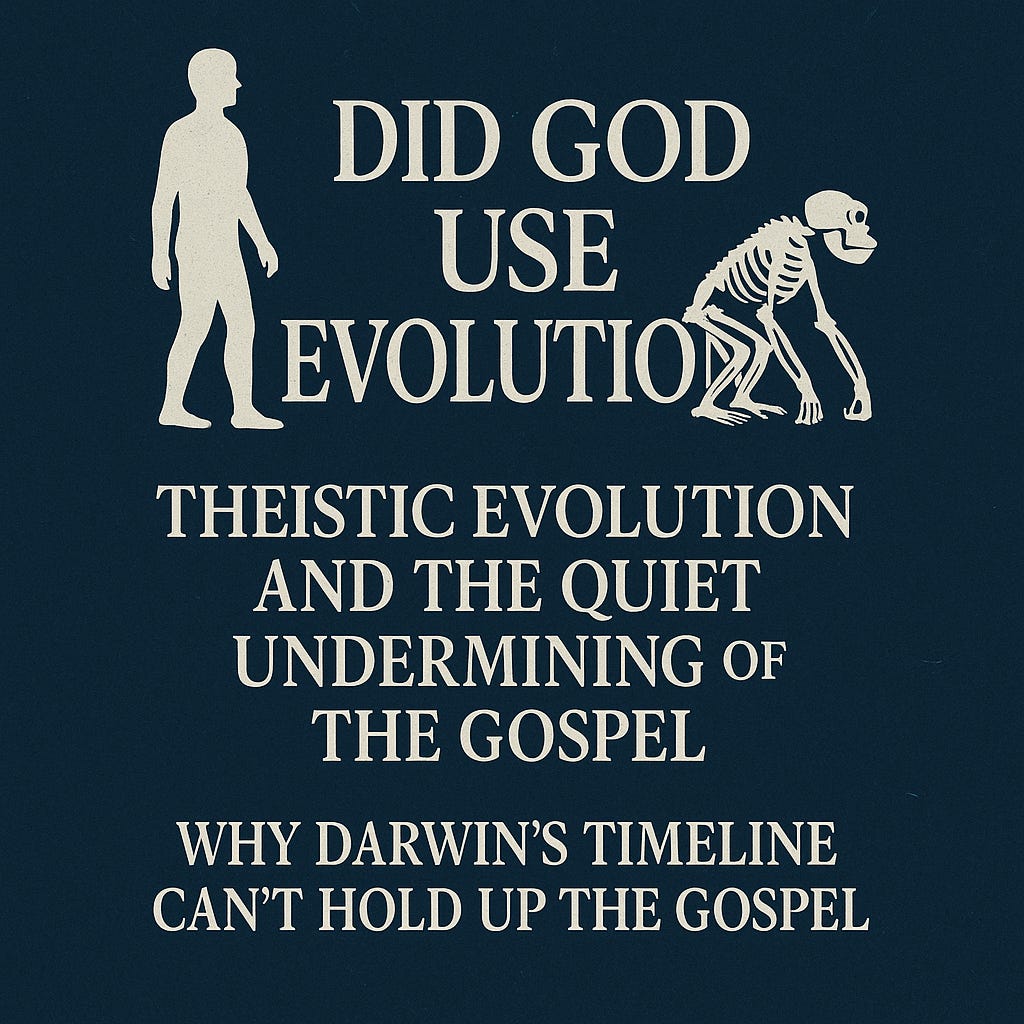
There’s been a peculiar form of theological yoga being practiced in some corners of the modern church for some time now—a kind of interpretive contortionism that tries to stretch Genesis into the shape of Darwin’s mystical fiction.
For those of us with academic experience, this isn’t a novel concept—but it remains pervasive within the broader church. And that’s a problem, because it reflects a deeper, ongoing issue: the prevalence of biblical eisegesis.
It goes by the name theistic evolution; the belief that God used the slow, grinding gears of evolution to bring about life as we know it today.
At first glance, this may seem like a harmless attempt to bridge faith and science. But under the microscope of biblical exegesis and actual science, theistic evolution doesn’t hold up. It’s a brittle hybrid, an evolutionary apologetic with neither the spine of Scripture nor the muscle of scientific rigor.
Here’s why.
1.Genesis Is History, Not Haiku
Let’s begin at the beginning.
Genesis 1–2 is not written like poetry. It’s a historical narrative, marked by the Hebrew verb structure (וַיִּקְטֹל “wayyiqtol”) that indicates past-tense sequential events- then like a divine logbook. Each day is bracketed with “evening and morning,” then labeled: “the first day,” “the second day,” and so on. This is how Moses writes history, not metaphor.
To claim that these are symbolic eras or literary metaphors is to ignore the internal literary cues and jump into genre gymnastics. If Genesis isn’t history, neither is Exodus. Neither is Abraham’s genealogy. Neither, eventually, is Jesus’ genealogy.
Genesis structured with wayyiqtol verbs, which are never used for poetry. They are standard for historical storytelling throughout the Old Testament, including in books like Exodus, Judges, and Kings.
Theistic evolutionists are forced to spiritualize the creation account to fit an external narrative. This is not interpretation—it’s eisegesis, importing foreign assumptions into the biblical text.
2.Hermeneutical Gymnastics: Reading the Bible Backwards
To embrace theistic evolution, one must twist the Bible in uncomfortable and unnecessary ways:
Adam must be symbolic, not historical, despite the fact that Paul grounds the Gospel in a real, historical Adam (Romans 5:12–19; 1 Corinthians 15:45).
The Fall becomes allegory, which neuters the doctrine of original sin and undermines the necessity of the Cross.
The Flood must be local, despite Peter’s testimony that the ancient world was destroyed by it (2 Peter 3:6).
“Very good” must include suffering, predation, and death—an odd endorsement from a holy and compassionate Creator.
To buy into theistic evolution, you must treat the early chapters of Genesis like an abstract painting: subjective, mysterious, and open to endless reinterpretation. You read the Bible through the lens of secular science, instead of reading science through the lens of God’s Word.
3.Scientific Rebuttal: Even Darwin Is Doubting Darwin
While many think Darwinian evolution is a closed case in the scientific world, leading researchers are increasingly skeptical of its explanatory power. Enter Stephen C. Meyer, a Cambridge-trained philosopher of science and director at the Discovery Institute.
In his appearance on The Joe Rogan Experience (world’s largest podcast), Meyer explained that:
The fossil record doesn’t support gradualism. The Cambrian Explosion shows fully formed complex life appearing suddenly without precursors.
DNA contains coded information like software, not the product of random mutation but of intelligent design.
Natural selection can account for small-scale variations (microevolution), but it cannot explain the origin of new genetic information needed to form new body plans or systems.
Meyer’s work, especially in The Return of the God Hypothesis, makes it clear:
If God were using Darwinian evolution, He chose the least efficient and most error-prone system available to accomplish what He could’ve spoken into being instantly.
And according to Scripture, that’s precisely what He did.
4.Theological Casualties: Death Before the Fall Is Doctrinal Dynamite
Here lies the most devastating consequence of theistic evolution:
it necessitates death before sin.
If natural selection brought us here, then death was a creative tool, not a curse. But Scripture says otherwise:
“Through one man sin entered the world, and death through sin…” (Romans 5:12)
“The wages of sin is death…” (Romans 6:23)
“The last enemy to be destroyed is death.” (1 Corinthians 15:26)
If death predates the Fall, then it’s not the result of sin. That means Jesus died to conquer an enemy that God Himself supposedly designed as part of a “very good” world.
That kind of compromise doesn’t clarify the Gospel—it clouds it.
As John Lennox, Oxford mathematician and renowned Christian apologist, puts it: “If evolution is true, then God created using death, struggle, and waste. But the Bible calls death the last enemy, not God’s assistant.” (Seven Days That Divide the World)
5.The Real Issue: Authority
This debate is not fundamentally about science. It’s about authority.
When you say Genesis doesn’t mean what it plainly says, you’ve handed interpretive authority to scientific consensus which changes every decade. You’ve replaced the Word of God with the Word of the Academy that currently can’t define what a woman is.
And it won’t stop at Genesis. Once you’ve allegorized Adam, Eve, the Fall, the Flood, and the genealogies, what will you do with the virgin birth? The resurrection? The Second Coming?
If we can’t trust what God said about the beginning, why should we trust Him about the end?
6.So What’s at Stake? Everything.
Theistic evolution strikes at the foundation of biblical authority, the nature of God, and the truth of the Gospel.
It undermines the doctrine of original sin.
It distorts the character of God, painting Him as an ambivalent tinkerer.
It reinterprets Scripture through the lens of fallen human speculation.
It diminishes the urgency of redemption. After all, if death is just a natural part of God’s original design—not a consequence of sin—then the cross becomes a cure for something that was never a curse.
In short, it’s not that theistic evolution simply adds to the Gospel, it replaces it with something foreign.
Final Thought: God Did Not Need Darwin’s Help
This isn’t about being anti-science. It’s about being pro-Scripture and honest about what science can actually prove.
The God of the Bible doesn’t stumble forward through eons of chaos. He speaks, and it is so. He forms man from the dust and breathes life into him. He makes woman from his side. He creates by divine fiat, not trial and error.
As G.K. Chesterton quipped: “Fallacies do not cease to be fallacies because they become fashions.”
In fact, theistic evolution often plays a quiet supporting role in the rise of deconstructionism — the unraveling of core doctrines under the guise of intellectual honesty. Once Genesis is up for reinterpretation, it’s not long before the rest of Scripture becomes negotiable too.
We've seen where that road leads as many well known professing Christians have left the faith (a whole other topic worthy of it’s own time) in recent history.
We must also recognize the ongoing need and command by Christ to shepherd well. The Church cannot afford to be vague where Scripture is clear. We need to raise up believers who know how to rightly handle the Word of truth; who can exegete, not just emote—so we can gently guard those who are less discerning, and guide them back to the solid ground of biblical authority.
Don’t keep it to yourself. Like it. Share it. Comment. Engage. Not for clicks, but for Kingdom solidarity that challenges cultural compromise and points back to the unshakable Word of God.
🌱 This mission doesn’t run on good intentions alone (though we have plenty).
🙌 It runs on prayer, provision, and people like you.
🤝 Every gift you give goes directly to gospel work: evangelism, discipleship, biblical teaching, and loving people well in places where the Church is barely visible — or completely absent.
❤️ So, if you've ever wanted to be part of something eternal without moving to the other side of the world or giving up coffee, here's your chance.
💡 Join us in the Great Commission — because planting, watering, and harvesting the Word of God takes all kinds of hands! (yours included)
Author’s Note:
This article wasn’t written out of frustration or to win an argument, it was written out of genuine concern. A recent conversation with a fellow believer who holds to theistic evolution reminded me just how quietly and widely this view has crept into the church.
This isn’t a personal critique of anyone’s faith, but rather a biblical response to an ongoing theological trend. My aim is not to stir controversy, but to lovingly clarify truth and encourage sound interpretation of Scripture. Ideas have consequences, especially when they shape how we understand God, the Gospel, and human identity. As believers, we are called to test everything by the Word, and that includes ideas that seem to offer harmony between science and faith.
So this isn’t a reaction. It’s a reflection, one rooted in conviction, carried by grace, and offered in love for the body of Christ.