

More than the midterm elections, the more urgent question is happening inside the church.
Americans recently went to the polls in a consequential midterm election that produced several historic firsts in religious and cultural representation, including the election of the first Muslim U.S. senator, the first openly gay man to the Senate, and even Conservative Alabama's first openly trans-identifying State legislator. Democrats won control of both chambers of Congress.
America is changing. That is not debatable.
But about the same time as the election, another report appeared. This one is one that professing Christians should pay at least as much attention to as midterm election results.
On November 3, Lifeway Research published findings from a survey testing American churchgoers’ basic knowledge of the Bible.
The results were terrible, to say the least.
Sixty-five percent failed.
The average score was just 51%. And only about 20% reported reading the Bible every day. Remarkable. These findings raise a question far more important than what the election says about America.
What does this report say about the church?
Because a church that stops knowing Scripture does not stop having opinions. It simply becomes increasingly unable to distinguish which of those opinions are biblical. And that is a problem with consequences far beyond what the talking heads on big media platforms say the doomsday outcomes will be.
As a seasoned shepherd of the Christian faith I personally know once said,
“The problem with those who profess to be Christians who stop coming to church and reading their Bibles is that they stop seeing those things as problems,”
echoing Jesus’s warning to His disciples:
“Remain in me, as I also remain in you. No branch can bear fruit by itself; it must remain in the vine. Neither can you bear fruit unless you remain in me. “I am the vine; you are the branches. If you remain in me and I in you, you will bear much fruit; apart from me you can do nothing. If you do not remain in me, you are like a branch that is thrown away and withers; such branches are picked up, thrown into the fire and burned.” -John 15:4-6.
The Overtly Changing Religious Landscape
Consider what has happened to America’s religious identity over the past two decades. According to the Pew Research Center’s Religious Landscape Study, approximately 78% of American adults identified as Christian in 2007. By 2023–24, that number had fallen to about 62%.
That’s a 16-percentage-point decline.
During the same period, the religiously unaffiliated population—those identifying as atheist, agnostic, or having no particular religion—grew from approximately 16% to 29%.
In other words, the proportion of religiously unaffiliated Americans has nearly doubled.
The country's religious composition is changing in other ways that are impossible to miss, even for expats like myself living outside the U.S. Pew’s research found that the percentage of American adults identifying as Muslim has essentially tripled, increasing from 2007 to 2023–24.
A threefold increase in Islam in the United States has begun in a country founded on Christian principles, which led to emancipation from slavery and has been the most benevolent country in human history.
These are significant long-term demographic changes, although Pew also reports that the decline in Christian identification has slowed considerably in recent years. Thankfully. This, of course, isn’t cause for pause on the discipleship front.
Also worth noting: we should be careful about what these statistics establish.
They do not prove that biblical illiteracy caused America’s religious transformation. Many factors influence religious affiliation, including generational change, immigration, religious switching, and personal conviction, among others. Nor does identifying as Christian necessarily mean someone possesses saving faith in Jesus Christ (Mt 7:21-23).
The Lifeway findings suggest that many churchgoers lack even foundational biblical knowledge.
That should concern us (Christians). If it doesn’t, we have another problem to discuss: apathy, which isn’t a fruit of the Spirit. But I digress…
A Church That Doesn’t Know Its Own Book
Lifeway surveyed American churchgoers who identified as Protestant, Catholic, or Orthodox Christian and typically attended church at least monthly. The survey examined their knowledge of biblical people, events, books, passages, and the Bible’s overall structure.
The researchers were not asking respondents to resolve complicated theological controversies. They were examining basic familiarity with Scripture.
And 65% scored below 60%.
Only 17% earned an A or B.
Perhaps even more revealing was the relationship between Bible reading and biblical knowledge. Those who reported reading Scripture daily averaged 66, while those who rarely or never read it averaged just 36.
The difference was thirty points.
Of course, correlation does not establish that daily reading alone caused the difference. People who read frequently may also be more motivated to study, attend Bible classes, or participate in other forms of discipleship.
It’s also worth saying what might be assumed: a quiz score is not a measure of someone’s salvation or intelligence. But neither should we dismiss what the results reveal.
Christians cannot faithfully interpret, teach, defend, and obey a Bible they scarcely know.
Scripture itself makes that connection.
Paul tells Timothy that the sacred writings are able to make a person wise for salvation through faith in Christ Jesus (2 Timothy 3:15). He then explains that all Scripture is God-breathed and profitable for teaching, correction, and training in righteousness, equipping God’s people for every good work (3:16-17).
Notice what Scripture does.
It teaches.
It corrects.
It trains.
It equips.
But how can it correct beliefs we never submit to it?
How can it train minds that seldom engage with it?
And how can Christians recognize false teaching when they cannot distinguish it from what God has actually revealed?
These are not hypothetical concerns. They are questions the Bible itself repeatedly raises.
Ancient Israel’s Warning to the Church Today
Before going further, I want to make something unmistakably clear.
America is not Israel.
The United States is not God’s covenant people, and no American political party has inherited Israel’s covenant identity. Nor am I claiming that a particular election result constitutes a divine judgment specifically revealed to me.
I am not Isaiah. I am not Jeremiah. And I have received no prophetic revelation explaining why voters elected one candidate over another. But Scripture explicitly commands Christians to learn from it, which absolutely involves Israel’s history.
In 1 Corinthians 10, the apostle Paul recounts Israel’s experiences in the wilderness. He reminds the Corinthian church that the Israelites experienced extraordinary privileges. They witnessed God’s deliverance, received His provision, and encountered His mighty works.
Yet still, many fell into idolatry, sexual immorality, rebellion, and unbelief.
Paul then explains why Christians should pay attention:
“Now these things took place as examples for us, that we might not desire evil as they did.” (1 Corinthians 10:6, ESV)
And again:
“Now these things happened to them as an example, but they were written down for our instruction.” (1 Corinthians 10:11, ESV)
Paul’s point is not that Corinth had become another political Israel. His point is that God’s people must learn from the consequences of unbelief and disobedience. And what does he warn the Corinthians against?
Precisely the kinds of spiritual compromise that had characterized Israel.
The Israelites did not simply live among people who worshiped other gods. They began participating in idolatry themselves. They adopted practices that violated God’s direct commands. They desired what God had strictly forbidden. And despite having witnessed His extraordinary provision and mercy, they repeatedly failed to remain faithful and obey Him.
This is a recurring concern throughout the Old Testament.
Through Hosea, God declared:
“My people are destroyed for lack of knowledge.” (Hosea 4:6, ESV)
In context, this was not a complaint about people performing poorly on religious trivia night at a Wednesday potluck fellowship. God was condemning covenant unfaithfulness, including the rejection of His law by those responsible for teaching it.
Their ignorance was joined at the hip with disobedience. They had received God’s revelation, seen God clearly work and redeem them, yet still rejected His instruction. The result was not spiritual neutrality.
It was spiritual corruption.
And Paul explicitly tells Christians that these accounts were preserved for our instruction. We would be willfully ignorant to ignore them.
The Problem: Not That Other Worldviews Exist
Consider what this means for Christians living in the U.S. where Christianity has been the predominant worldview since its founding. As a native Tennessean, I’ve witnessed some of these changes firsthand. This past summer, I met a friend for lunch in a predominantly Somali commercial area of Nashville. The concentration of Muslim-oriented businesses and community life was striking compared with the Nashville I remember from years ago.
And this is not merely anecdotal. Pew's September 2026 report estimates that America's Muslim population grew by 129% between 2007 and 2026 (calculated from Pew’s figures). Nashville's planning documents already identified substantial Somali and other immigrant communities along its southern corridors in 2011 and 2017, noting, for the sake of not forgetting, that this was happening deep in the heart of the Bible Belt.
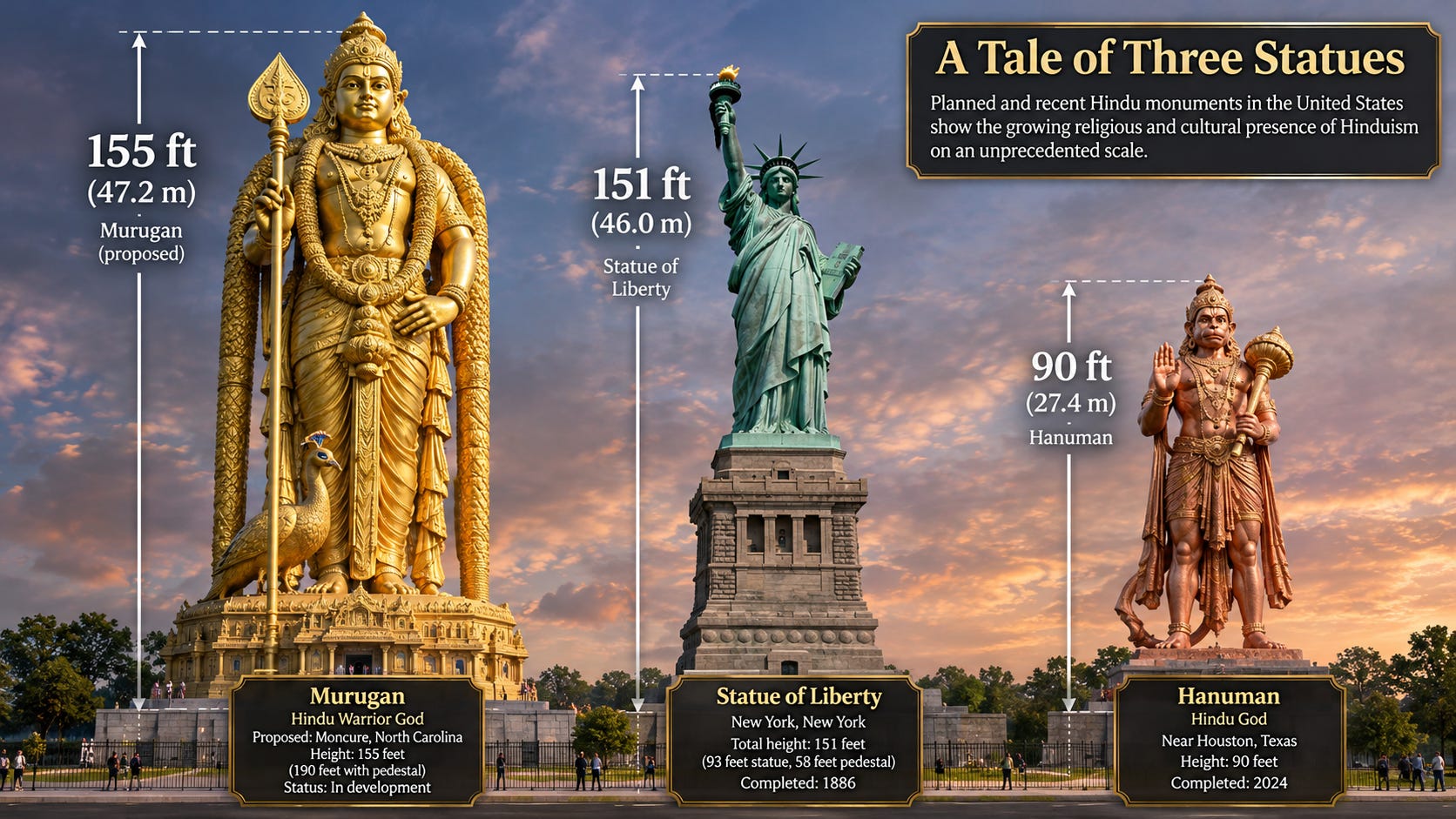
But even outside the heart of the Bible Belt, a massive 155-foot statue (taller than the Statue of Liberty) of a Hindu god is planned for North Carolina, and a 90-foot-tall statue of the monkey-headed Hindu god Hanuman was built on the outskirts of Houston in 2024.
The problem is not that Muslims exist.
The problem is not that Hindus exist.
The problem is not that secular people exist.
The problem is not that people who reject Christian teaching participate in American public life.
Christians are commanded to love their neighbors, pray for others, speak truthfully, and proclaim the gospel to every nation. The problem arises when the church becomes so biblically malnourished that it no longer knows how to faithfully engage those neighbors.
How will Christians respond to Islam if they cannot explain who Jesus Christ is, why He is the eternal Son of God, or what His death and resurrection accomplished (which Islam completely denies)?
How will Christians engage with secular understandings of morality, sexuality, the LGBT lobby and its incessant colonizing efforts, even in elementary school libraries, and human identity if they cannot explain what Scripture teaches about creation, the image of God, sin, judgment, and redemption?
How will Christians distinguish the biblical gospel from the teachings of the Church of Jesus Christ of Latter-day Saints or Jehovah’s Witnesses if they cannot articulate the gospel themselves?
How will Christian parents disciple their children if they cannot explain what God commands, what He forbids, and why?
And how will Christians recognize when a political party (Republican or Democratic) demands allegiance at the expense of obedience to Christ if they no longer know the biblical standard?
These questions are not peripheral to Christian discipleship. They concern our ability to recognize truth, resist error, and contend for the faith once for all delivered to the saints (Jude 3).
The writer of Hebrews rebukes believers who ought to have matured in their understanding but still require elementary instruction. He contrasts their immaturity with those who have their powers of discernment trained through constant practice to distinguish good from evil (Hebrews 5:11-14).
Paul likewise instructs Christians:
“Do not be conformed to this world, but be transformed by the renewal of your mind.” (Romans 12:2, ESV)
Why?
So that believers may discern the will of God.
Biblical discernment is not simply knowing which political positions to support. It is learning to evaluate every belief, desire, and allegiance under the authority of God’s Word.
That includes our own.
In fact, Christians should be particularly cautious when Scripture challenges their preferred political positions. It is remarkably easy to find Bible verses that appear to support what we already believe. It is much harder to allow Scripture to correct us when we are wrong. But that is precisely what Christians are called to do.
When the Voice of God Becomes Unfamiliar
Through the prophet Amos, God warned Israel of a coming judgment:
“Not a famine of bread, nor a thirst for water, but of hearing the words of the LORD.” (Amos 8:11, ESV)
This was a specific prophetic warning against ancient Israel. It was not a prediction about the 2026 American midterm elections. But its seriousness should not escape us. To be deprived of hearing God’s Word is a terrible thing. And there is something especially sobering about our present circumstances.
In much of the United States, Christians are not deprived of access to Scripture. We have Bibles in our homes. Bibles on our phones. Audio Bibles. Study Bibles. Bible commentaries. Bible-reading plans. And the occasional, albeit too infrequent, Bible Study invitation.
More access to Scripture than most generations of Christians could have imagined. Yet access does not guarantee understanding. And familiarity with the existence of the Bible is not the same as familiarity with its contents. We can possess God’s Word while allowing nearly every other voice to shape our thinking more profoundly.
Political commentators. Social media personalities.
Cultural movements. Religious teachers.
Our own preferences and prejudices.
And eventually, beliefs that contradict Scripture may begin to seem perfectly reasonable because the biblical standard has become unfamiliar. My wife and I are seeing this even in our own kids’ school library at a Christian elementary school, where graphic novels are tolerated that normalize LGBT portrayals of sexuality, same-sex attraction, and gender identity. It’s a sad state of affairs, to say the least, when those entrusted to exercise Biblical prudence in such matters can’t or won’t explain how they apply the alleged Biblical standard while providing such material to students at a Christian school.
One can only speculate why such tolerances exist among the professing Christian body, but when no Biblical support is provided for such decisions, it’s a safe bet they don’t know their Bibles. Lord, help them.
When the voice of God becomes unfamiliar, every other voice becomes easier to believe.
This is not to suggest that every Christian who struggles with Bible reading is a spiritual apostate. Nor does reading Scripture daily automatically make someone spiritually mature. Jesus rebuked religious leaders who searched the Scriptures yet refused to come to Him for life (John 5:39-40).
In contrast, James, Jesus’s brother, compares this kind of religion to what demons practice (James 2:19). They know God is there. They know God is holy. They know God is one. They just choose to disobey and defy Him.
Before Asking What Happened to America
I do not think the first Christian response to the election should be panic (nor triumphalism). It should be self-examination. Before asking, “What happened to America?”, Christians should ask:
What has happened to us?
Do we actually know the Scriptures?
Do we study them carefully, or merely repeat platitudes like, “let your life speak,” as if it’s something Jesus said in his Sermon on the Mount?
Do we allow God’s Word to correct our assumptions (political or otherwise), or do we use it selectively to defend them?
Do we teach Scripture to our children, or do we outsource that responsibility to flippant hope and the occasional exposure to those we presume teach Scripture faithfully when those paths randomly cross?
Can we explain the gospel clearly to a Muslim neighbor, a secular colleague, or a friend who has embraced a false gospel, such as those promoted by Mormons and Jehovah’s Witnesses, which present mystical gnostic knowledge only they can provide?
Do we believe Scripture is sufficient (completely sufficient) to teach us, correct us, rebuke us, and train us in righteousness?
And perhaps most importantly:
Are we willing to obey what God has said, even when doing so contradicts what we would prefer to believe?
These questions should concern every professing Christian, regardless of political affiliation. Because the church’s greatest danger will never be that the wrong party controls Congress.
The church’s greatest danger is unfaithfulness to Christ.
And no political majority can remedy that.
The answer to biblical illiteracy is not merely another church program, another conference, or another social media campaign.
It begins with repentance.
A return to the Word.
Associated Press. Calling control of Congress in the 2026 midterm elections. November 5, 2026. Confirmation of Democratic victories in both chambers.
Lifeway Research / Baptist Press. 2 in 3 churchgoers fail Bible literacy quiz. November 3, 2026. Survey of 2,012 American Christian churchgoers, conducted August 12–29, 2026. Includes Bible-knowledge scores and reading habits.
Lifeway Research / Baptist Press. Fewer than 1 in 3 churchgoers read the Bible daily. February 10, 2026. Separate study finding that 31% of Protestant churchgoers reported daily Bible reading.
Pew Research Center. Decline of Christianity in the U.S. Has Slowed, May Have Leveled Off. February 26, 2025. Religious Landscape Study, covering religious identification and long-term demographic changes.
Pew Research Center. Religious Identity in the United States. February 26, 2025. Detailed figures for Christianity, religious nonaffiliation, Islam, and other religions.
Pew Research Center. 25 Years After 9/11, a Portrait of Muslim Americans.
The Christian Broadcasting Network. Massive Hindu Idol to Be Raised in US State, Taller Than Statue of Liberty.